
This all looks straight forward. If you use in-network doctors, you pay less than if you go out-of-network. That’s pretty standard stuff these days. The idea is that in-network providers have agreed to lower negotiated fees so both the plan and the patient pay less. They have agreed to that in part to keep you as a patient and in some cases to help add to their patient base.
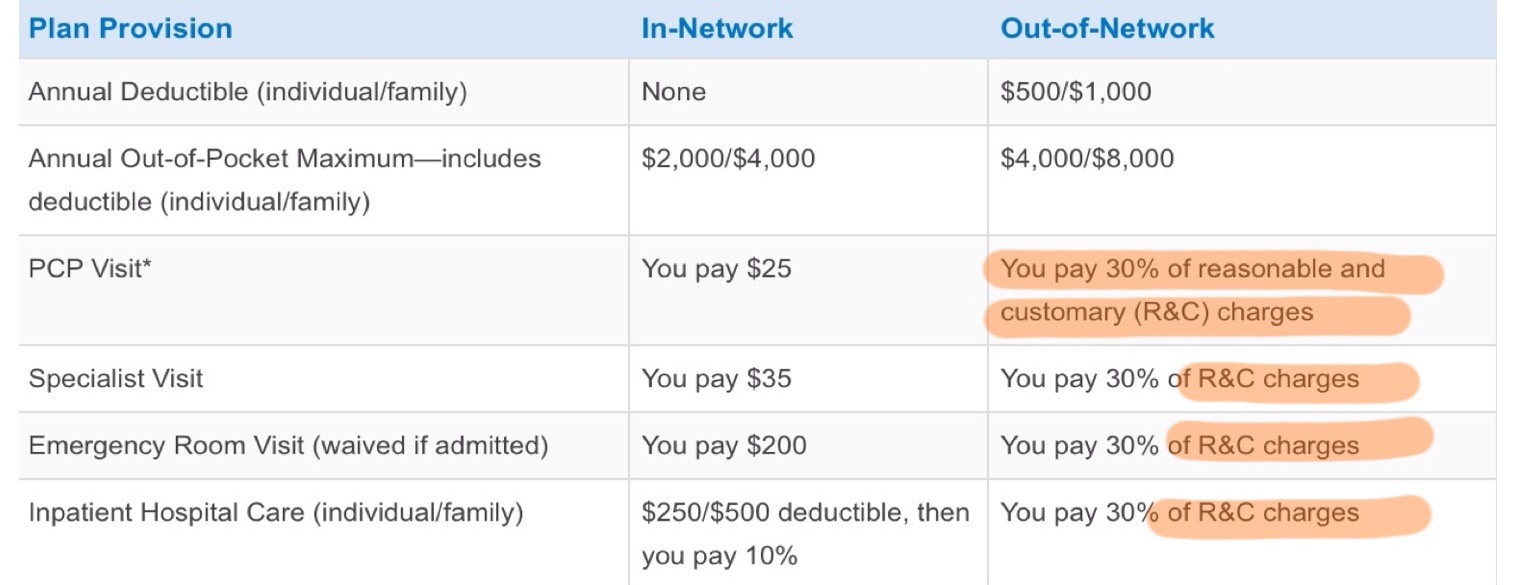
To provide flexibility most health plans allow you to use a provider of choice; for a price. In this example that price if 30% coinsurance as opposed to a fixed co-payment.
That’s what you think‼️
Look closer, you pay 30% of the R&C charges. R&C stands for reasonable and customary. Now consider that the main reason doctors do not participate in a network is because they won’t accept the negotiated fee. In other words, they charge more than their peers; likely more than what the insurance company determines to be reasonable and customary.
Let’s say out of 100 doctors 80 of them charge $1,000 or less for a procedure and 20 will charge more. The R&C fee limit is set at $1,000. Now say you use a doctor not in your network and his charge is $1,500 for this procedure.
 You must pay 30% in our example, right? Wrong‼️
Instead of paying 30% or $450, you will pay $300 (30% of $1,000 – the R&C fee) plus 100% of the amount above the R&C or another $500. Going out of network cost you $800; you actually pay 53% of the total cost AND the excess you paid probably does not count toward your out-of-pocket limit.
Now, make sure you read and understand all the information you are provided‼️

 QUINNSCOMMENTARY