
You don’t need a law to inhibit free speech. Sometimes bullying, coercion and threats do the job.
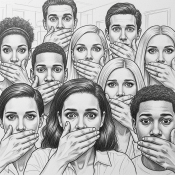
- Freedom of the Press: This protects the ability of the media to report news and information without government censorship.
- Freedom of Speech:The government cannot abridge, or limit, an individual’s right to express their thoughts and opinions.
“Congress shall make no law respecting an establishment of religion, or prohibiting the free exercise thereof; or abridging the freedom of speech, or of the press; or the right of the people peaceably to assemble, and to petition the Government for a redress of grievances.” December 15, 1791
Attacks by our president on the press, the media, education and individuals because they criticize or simply disagree with his views and policies seem the norm these days.

Something isn’t right in America.
A Gallup survey out earlier this year showed that the percentage of Americans identifying as “moderate” declined from 43 percent in 1992 to 34 percent in 2024. We are focused not only left and right, but often on extremism driven by fear, fear fostered by politicians.
Your dignified, honest, civil President in action 9-18-25 How does such rhetoric help our Country?

She came to the US thirty years ago. Omar became a U.S. citizen in 2000 at age 17 when her father became a naturalized citizen. Nothing to do with a marriage.
Ilhan Omar has explicitly and repeatedly denied the rumors that she married her brother. The false claims were spread online during her political career and have been debunked by journalists and public records.
We have a president perpetuating rumors, calling a member of Congress “scum” and trying to link her with a country she left as a child.
His comments in the TruthSocial post are offensive, incoherent and disingenuous…How can any decent person find this behavior acceptable by anyone let alone by the President of the United States?
She is a black woman, a Muslim and a Democrat and she opposes Trump’s actions…and this attack is the consequence.
Here are some examples of Donald Trump attacking critics, based on publicly reported incidents. These examples focus on his rhetoric and actions toward individuals or groups who have opposed or criticized him, as documented in various sources:
1. Attacks on the Media: Trump has frequently targeted media outlets and journalists who report critically on him. Since taking office in January 2025, he has been noted for waging an aggressive campaign against the media, including cheering the suspension of Jimmy Kimmel’s late-night show after Kimmel criticized the MAGA movement. Trump stated on Truth Social, “Congratulations to ABC for finally having the courage to do what had to be done.” He has also filed lawsuits against outlets for unfavorable coverage and threatened to revoke TV broadcast licenses.
2. Blocking Reporters: In February 2025, Associated Press reporters were barred from covering White House events for two days after the outlet refused to use Trump’s preferred term, “Gulf of America,” instead of “Gulf of Mexico.” This was part of a broader pattern of limiting media access to outlets critical of his administration.
3. Verbal Attacks on Journalists: Trump has a history of verbally berating reporters. For instance, in September 2025, he snapped at journalist Yamiche Alcindor, saying, “Be quiet, listen! You don’t listen, you never listen. That’s why you’re second-rate,” after she questioned him about a threatening post regarding Chicago. This was not the first time he targeted her with such remarks.
4. Labeling Critics as “Haters” and “Lunatics”: Trump has frequently used derogatory terms like “haters,” “bad people,” “fake,” or “radical left lunatics” to describe his critics. In a September 2025 speech, he referred to a “Radical Left group of lunatics” and vowed to “get that problem solved,” framing his opponents as threats to the country.
5. Social Media Attacks: Trump has used platforms like Truth Social and Twitter to target critics directly. According to an analysis by the Freedom of the Press Foundation, he posted nearly 3,500 social media attacks on the press over a decade, averaging about one per day. These often label the media as “fake news” or “the enemy of the people.”
6. Rhetoric Against Political Opponents: In an October 2024 interview with Fox News, Trump called his political opponents “the enemy from within” and suggested deploying the military or National Guard against “radical left lunatics” to prevent election chaos, a statement critics described as authoritarian.
7. Encouraging Crowd Hostility: At campaign rallies, Trump has incited supporters to boo and jeer at journalists. During a September 2024 rally in Uniondale, New York, he pointed out the press corps, calling them “fake news media,” prompting the crowd to denigrate reporters. This has become a recurring feature of his events.
9-19-25
U.S. Attorney Investigating Two Trump Foes Resigns After President Seeks to Oust Him

 QUINNSCOMMENTARY
Administrative challenges to media/broadcast go way, way back, prior to the day almost everyone reading this was born.
Here is an exhaustive analysis/summary.
Tuesday, August 26, 2025
By Jeff Jacoby, Boston Globe Opinion columnist
Pull the plug on the FCC
Like 99.5 percent of American adults, I wasn’t watching Jimmy Kimmel’s show on ABC last week when he made his unfunny comment suggesting that the man charged with the murder of conservative activist Charlie Kirk was part of “the MAGA gang” now trying “desperately” to distance itself from the accused killer. It was a cheap shot, and Kimmel was rightly criticized for his tastelessness. Then again, tasteless jokes are hardly a rarity in late-night television. If every comic who crossed the line into mean-spiritedness or bad judgment were sent packing, there would be no one left on network TV after 11:30 p.m.
Yet as disgraceful as Kimmel’s crack was, what happened next was far worse. Within a day and a half, Federal Communications Commission chairman Brendan Carr was publicly urging licensed broadcasters to declare that “we’re not going to run Kimmel anymore.” He emphasized his demand with an unsubtle warning: “Broadcasters … have a license granted by us at the FCC, and that comes with an obligation to operate in the public interest. When we see stuff like this, look, we can do this the easy way or the hard way.” Nice TV operation you have here. Be a shame if something were to happen to it.
Almost immediately, station owners Nexstar and Sinclair capitulated, announcing that “Jimmy Kimmel Live!” would stop appearing on their affiliates. Then ABC yanked Kimmel’s show. The speed of the surrender was as chilling as the threat itself. What looked at first like another fleeting late-night controversy turned out to be an alarming display of authoritarian muscle, backed by the power of federal regulation. (Late Monday, following days of controversy, ABC’s parent company Disney announced that “Jimmy Kimmel Live!” would return to the air Tuesday.)
The cancellation was scandalous. An insipid crack from a late-night TV host may be regrettable, but it is not a threat to the republic. What is a threat is politicians and regulators exploiting their authority to stifle voices they dislike. Carr used the power of the FCC not to protect the public interest, but to punish a critic of the president who appointed him.
Only a naïf can imagine that this abuse will end with Kimmel, or with Stephen Colbert — another Trump critic whose show was cancelled by CBS a few weeks earlier. If government officials are allowed to get away with weaponizing broadcast licensing to intimidate or gag their critics, they will keep doing it. And when the “out” party regains power, its officials will do it too. The real late-night obscenity isn’t what an entertainer said about the Kirk assassination. It’s that federal regulators have the power to shut him down for saying it.
FCC Chairman Brendan Carr used to hold himself out as a fierce defender of free speech. Then Republicans won the White House.The gall of Carr’s maneuver is compounded by its sheer hypocrisy.
This is the same Brendan Carr who not long ago held himself out as one of Washington’s fiercest defenders of free speech. As the Foundation for Individual Rights and Expression recounts, when Democrats in Congress tried to pressure broadcasters over their coverage of COVID-19 and the 2020 election, Carr called it “a chilling transgression of the free speech rights that every media outlet in this country enjoys,” insisting that “a newsroom’s decision about what stories to cover and how to frame them should be beyond the reach of any government official.”
Likewise, when members of Congress urged the FCC to block the transfer of a Miami radio station because they disliked the political views of the prospective owner, Carr excoriated their efforts as an outrageous gambit “to inject partisan politics into our licensing process,” and denounced the “deeply troubling transgression of free speech and the FCC’s status as an independent agency.”
Yet now, when it suits his political patron, Carr does precisely what he once decried, wielding the FCC’s hold over licenses as a weapon to muzzle speech.
For years, Republicans and Trump supporters fumed when Democrats twisted the arms of media companies. They denounced the Obama administration’s pressure campaigns against Fox News and its drive to prosecute public employees who talked to the press. Trump supporters similarly raged at the Biden White House for nudging social media platforms to squelch pandemic “misinformation” or to suppress stories embarrassing to the president. They were right to fume: When government bullies media outlets into toeing a partisan line, it is assaulting the First Amendment.
But that principle is supposed to cut both ways. The same conservatives who once warned of the dangers of politicized broadcasting now applaud when Trump’s FCC chairman openly threatens to pull licenses unless critics’ shows are cancelled.
Nothing corrodes a constitutional principle faster than treating it as a partisan plaything. If you rail against censorship when Democrats do it, but cheer when Republicans do it, what you are defending isn’t freedom but two-faced factional advantage. Carr and Trump have dragged the GOP into the very swamp of speech suppression they used to pretend they found abhorrent. Their followers, in celebrating the silencing of liberal comedians, ought to be reminded that the same regulatory cudgel can — and inevitably will — be swung against them when the political tide changes.
Carr’s threats have a long and ignoble pedigree. From the earliest days of federal oversight of the airwaves, politicians have deployed the FCC’s authority to suppress speech they disliked. Indeed, abuse of the First Amendment is woven into the agency’s history.
Franklin D. Roosevelt , for example, made little secret of his determination to rein in radio critics during the 1930s. When broadcasters aired speeches hostile to the New Deal, his administration retaliated by siccing regulators on them. By 1939, the National Association of Broadcasters’ “codes” required advance review of political broadcasts. Radio executives, fearful of losing their licenses, quashed controversial programming.
“It did not take long for broadcasters to get the message,” historian David Beito wrote in Reason magazine in 2017. “CBS Vice President Henry A. Bellows said that ‘no broadcast would be permitted over the Columbia Broadcasting System that in any way was critical of any policy of the Administration.’” In fact, Bellows said, CBS considered itself to be “at the disposal of President Roosevelt and his administration.”
That pattern only intensified once the FCC began codifying rules about “fair” and “balanced” coverage. In 1949, the agency adopted the so-called “Fairness Doctrine,” which required broadcasters to present all points of view on controversial issues of public importance. Though in theory the doctrine was about balance, in practice it became a weapon to strengthen incumbents.
Broadcast pioneer Fred W. Friendly, who became president of CBS in the 1960s, described in one of his books how President John F. Kennedy’s aides urged the use of Fairness Doctrine complaints to tie up conservative radio stations. Friendly quoted the blunt summary of one top JFK official, Assistant Secretary of Commerce Bill Ruder: “Our massive strategy was to use the Fairness Doctrine to challenge and harass right-wing broadcasters,” making it so costly to criticize the administration “that they would be inhibited” into silence.
Similar intimidation and abuses occurred during the Lyndon Johnson and Richard Nixon administrations, which used the Fairness Doctrine to ensure unfairness, intimidation, and censorship. The doctrine was finally scrapped by President Reagan in 1987. Only then did talk radio and other robustly opinionated formats take off.
Even without the Fairness Doctrine, however, the mere existence of the FCC and its power to issue broadcast licenses means that the federal government can flex its muscle to police any speech it doesn’t like. In a badly misguided 1969 case, Red Lion Broadcasting v. FCC, the Supreme Court ruled that statutory limits on broadcasters’ free speech rights may be restricted by Washington, so long as those restrictions are in the “public interest.” And what qualifies as the public interest? That is for Congress and the FCC to decide.
Across decades, Republican ascendancy has alternated with Democratic upsurges, but the pattern hasn’t changed: When government holds the power to decide who may broadcast, that power will be used to punish dissent. Carr and Trump are today’s offenders, but the real problem is structural.
The United States has never required government licensing of newspapers, magazines, or book publishers. Nor does Washington have any power to dictate who may run a website, produce a podcast, or launch a streaming service. The First Amendment forbids all such meddling.
Yet, unique among communications media, broadcast radio and television remain subject to federal licensing. A network can be silenced not because viewers desert it or advertisers pull their support, but because Washington disapproves of its content. That power is fundamentally incompatible with freedom of the press. The Constitution doesn’t say, “Congress shall make no law … abridging the freedom of speech, except for speech that uses radio waves.” It doesn’t make an exception for late-night comedy. It doesn’t empower political appointees to decide which TV shows Americans may watch.
Why does the FCC even exist? Defenders of the agency usually fall back on one justification: The broadcast spectrum is “scarce,” they say, and frequencies must be rationed by government. But that argument has never made economic sense, and it makes even less sense now. Every human good is scarce in some sense — land, water, food, energy, microchips — yet no one suggests that federal regulators should assign ownership of farms or allocate grocery stores. Scarcity is best managed through markets, contracts, property rights, and local governance. The same mechanisms that ensure we can productively use land, or compete peacefully in selling food, or print rival newspapers, can ensure that broadcast signals don’t interfere.
The “spectrum scarcity” excuse has always been a pretext for regulation, not a justification for it. Thanks to technology, the usable spectrum has expanded vastly since the 1920s. And with the rise of cable, satellites, streaming services, and the internet, broadcasting is only one of many ways Americans communicate. If the FCC vanished tomorrow, Americans would still have abundant ways to get news, entertainment, and information — and broadcasters would readily find ways to coordinate frequencies without government censors breathing down their necks.
The real issue here isn’t technology but liberty. A free people must not entrust politicians with the power to silence critics. A nation committed to the First Amendment must not tolerate a federal agency with the power to decide who may broadcast and what they may say. As long as the FCC exists, the temptation to abuse its power will be irresistible — and that temptation will be indulged by whichever party holds power in Washington.
Conservatives cheering today as Kimmel and Colbert are driven off the air should pause to remember that someday soon Democrats will hold the whip hand. They will not hesitate to use FCC leverage against conservative broadcasters, Christian radio, or Fox News. The only way to prevent such abuses tomorrow is to remove the means of abuse today.
To my mind, Kimmel is not remotely a sympathetic character. There is good reason why 99.5 percent of Americans didn’t watch his show. Nonetheless, for that show to be cancelled via government bullying was an outrage — and a perfect demonstration of how dangerous it is to allow Washington to hold veto power over broadcast content.
The First Amendment promises Americans freedom of speech and of the press. That promise will never be secure so long as the FCC exists.
LikeLike
Where were you when the Biden Administration was limiting free speech – threatening all of the social media folks unless they curtailed commentary they disagreed with?
https://www.usatoday.com/story/money/2023/09/08/biden-administration-coerced-facebook-court-rules/70800723007/
Where were you when the Obama Administration started investigating journalists at Fox News?
https://www.cbsnews.com/news/fox-news-reporter-secretly-monitored-by-obama-administration-court-documents/
At least the idiot ass Trump’s threats to cut off the media, his criticisms of the media, etc. are in the public, and so far, haven’t been acted upon.
Beware those who gin up investigations or limit speech without any public disclosure. I can only guess what we don’t know that we don’t know.
LikeLike
Al Lindquist
Good work per usual Jack–folks like Quinn could have cared less–whatever it takes to bring Trump down they are for it–these government agencies that the lefties used to love they now hate as they are turned against them–I guess that never occurred to them.
LikeLike
Do you seriously believe that Donald Trump is the type of person/human being you want as a role model for our children, that he shows admirable behavior, integrity, civility and respect for others.
Do you find it acceptable he calls a member of Congress “scum” and lies about her on his social media? None of that bothers you or that he routinely lies outrageously.
Forget left or right or Dem or Rep the man, the individual is dangerous to our society.
As long as you don’t like lefties, make sure you don’t use any of the benefits their laws provide.
For what it’s worth, I never voted democratic in my 82 years.
LikeLike
Al Lindquist:
lefty programs, as proposed, usually expand the government but as you well know they do not pay for themselves–my rule is ; “if I am paying I am playing” so, if there are benefits for me like a new bridge crossing the Hudson, I assume some of my tax dollars paid for it so no guilt crossing on it.
I agree with you 100% on language and decorum–I pretty much avoid watching him–he is a giant embarrassment.
But with me I ask; “what’s the alternative”? AOC (hear her on the floor yesterday about Kirk?)– Bernie? Maxine Waters? Jasmine Crockett? Where do these folks come from–the new guy in NYC I withhold judgement as I give him a year or more before we see some results. Can’t be worse than De Blasio or the two recent mayors in Chicago.
The new cast of left wing characters they have would usher in more and more government.
A poll yesterday shows Trump under water on crime–the Democrat Party way under water–far below Trump. Right now Trump is bad but the alternative seems to be worse.
LikeLike
Wh
LikeLike
OMG, another case of TDS
LikeLike
You seriously don’t see what is happening and are not concerned?
LikeLike
Al Lindquist:
where was your concern when cancel culture was shutting down folks who disagreed with the prevailing notion on origin of Covid virus or maybe seniors should be getting shots but no reason to shut down schools.
Where were you when colleges inviting conservative speakers saw the lefties smash doors, windows, and attack the stage of speakers. Only now do you stand up for speech–how brave of you!
Tim Waltz is a real purveyor of shutting down speech saying that the “1st Amendment does not doesn’t protect all speech including hate speech.” It does of course.
Not too long ago he went on a rant saying free speech needs to be modified in the wake of Trump and his fascism. Sen. Kaine (D-VA) last week was interviewed on CNN and the clip of Waltz was played–Kaine avoided it like a hot potato.
John Kerry: sees the 1st Amendment “as a major block to be able to just, you know, hammer disinformation out of existence.”
Look, if Trump should not denigrate reporters and insult those folks/groups you mentioned I am with you 100%–but when folks like you use Hitler–Nazi–Fascism to describe folks, including Trump, then you lose credibility. Eisenhower was asked to criticize McCarthy and he responded; “I won’t get in the gutter with him”.
LikeLike