at the expense of the middle class
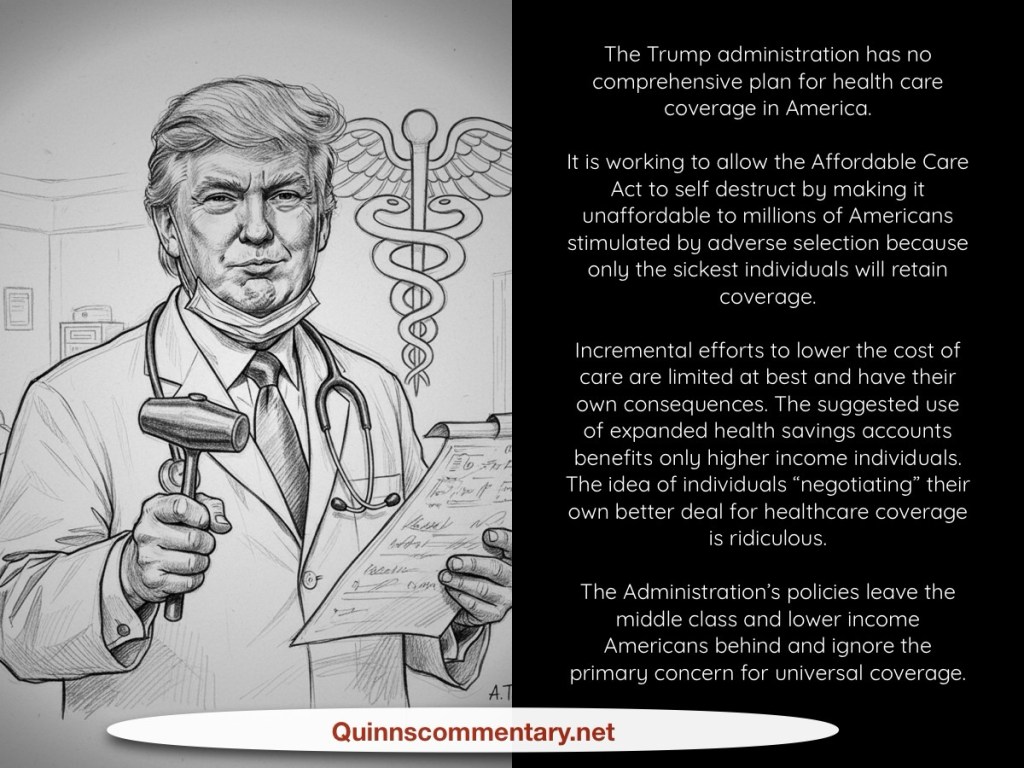

We can’t control what others do and we can’t stop misfortune from striking. But we can control our own actions. Those who are financially prudent will most likely enjoy success, even if events don’t always go their way.
at the expense of the middle class

 QUINNSCOMMENTARY
Here is the other challenge, Medicare is not sustainable in its current structure – where the costs continue to grow much faster than the economy.
Part A has a trust fund which is on its way to being exhausted and only because of added subsidies diverted from general revenues is it holding out past 2033 (when the Social Security trust fund is projected to be exhausted).
And, of course, Part B and Part D have no trust fund monies – those are already funded by general revenues.
As soon as the Beltway idiots stop lying to Americans, they can start to craft solutions to first stop adding to the debt and then, start reducing the accumulated debts.
https://www.cato.org/blog/why-we-cant-grow-our-way-out-medicare-driven-debt-crisis
LikeLike
One More Thought on Extending the Subsidies – Economists would identify the cost not only in dollar terms, but in terms of tradeoffs and alternatives, foregone opportunities – what could that money have bought which would be more effective at achieving “affordability”.
I disagree with the author here only in that she concludes saying: “… Federal policymakers face difficult choices about how to allocate public resources. …” These are not public resources. They are taxes, confiscation of wealth … and worse, it isn’t the obvious, current, notorious confiscation of wealth from today’s taxpayers, but the stealing from Americans too young to vote and generations unborn.
https://cosm.aei.org/if-you-care-about-poverty-ditch-the-aca-expanded-subsidies/?
If you care about poverty, ditch the ACA expanded subsidies
COSM Commentary
December 23, 2025
By Angela Rachidi
My AEI colleague Mark Warshawsky recently wrote an excellent summary of policy reasons not to extend the COVID-era enhanced ACA subsidies. His explainer adds to a substantial body of work (examples here, here, and here) describing the policy problems with the enhanced subsidies, notwithstanding their largely positive treatment in the popular media. Another important reason to consider: the enhanced subsidies do little to reduce poverty at substantial federal cost. Undoubtedly, this will make it more challenging to find funding to support anti-poverty efforts.
The US Census Bureau publishes two main poverty measures, the official (OPM) and supplemental (SPM). Neither incorporates the value of health insurance into the measures’ thresholds and resources. However, the Census Bureau published a working paper in September 2025 that presents their Health Inclusive Poverty Measures (HIPM), which essentially modifies the existing SPM to incorporate health insurance expenses and resources; resources such as benefits from Medicaid, Medicare, the Children’s Health Insurance Program (CHIP), and marketplace exchange subsidies.
Using the Census Bureau’s HIPM, in 2024 the marketplace subsidies (including the ACA enhanced subsidies available in that year) brought 2 million people out of poverty, including 310,000 children. It is unclear how much of this reduction is due to the enhanced subsidies currently being debated. However, almost all US children and many adults with poverty-level incomes receive Medicaid or CHIP, which already removes many of them from poverty (15.0 million according to the HIPM), making the enhanced subsidies irrelevant for many people in poverty. The enhanced subsidies target higher income households (i.e., households with incomes above 400 percent of the federal poverty level), making any potential effect on poverty minimal.
The debate over the enhanced ACA subsidies comes on the heels of recent policy debates over proposals to expand the Child Tax Credit (CTC) aimed at supporting children and their families. The American Rescue Plan increased the CTC temporarily in 2021 and expanded it to families without any earnings. Congress failed to extend the expanded CTC, largely due to concerns over cost and negative employment effects, but the previous CTC remains. Along with the existing earned income tax credit (EITC), together these refundable tax credits lifted 6.2 million people from poverty in 2024, including 3.4 million children, according to the HIPM.
It may be unfair to pit the two policy proposals against each other—the ACA’s enhanced subsidies and an expanded CTC—but both proposals are extremely costly and rarely include offsets to cover the cost. With finite federal resources, policymakers must confront choices about how and where to prioritize new spending.
According to the Congressional Budget Office, the cost of extending the enhanced subsidies is roughly $350 billion over 10 years. In a recent report for the National Academies of Sciences on federal policy options to reduce child poverty (which I was a part of), we identified 16 different proposals aimed at reforming the CTC to reduce child poverty. Some of these proposals were similar to the 2021 American Rescue Plan temporary expansion to the CTC, while the others included both less and more generous options.
Unsurprisingly, the least expensive options reduced the number of children in poverty by less than the most expensive options. Yet still, the least expensive options brought between 500,000 and 1 million children out of poverty at minimal cost while the most expensive eliminated poverty for 4.8 million children, at a cost of $201 billion per year. The effects on poverty generally, and child poverty specifically, were far larger for the CTC proposals than what the enhanced ACA subsidies would ever achieve at similar costs.
Federal policymakers face difficult choices about how to allocate public resources. This means that setting priorities and accepting fiscal trade-offs is essential. If policymakers want to preserve room to fund programs that reduce child poverty in future legislation, they should forgo extending the ACA’s enhanced subsidies now.
LikeLike
Found this enlightening, by noted expert Mark Warshawsky
Policy Reasons to Not Extend Covid-Era Enhanced ACA Subsidies
December 19, 2025
The recent lengthy federal government shutdown was caused by demands to extend COVID-era enhanced subsidies for Affordable Care Act (ACA) health insurance policies. In its discussions of the subsequent congressional votes, the media has focused on the increase in premiums and potential loss in coverage that would result for current enrollees from a non-extension, often expressing exasperation that Congress has not passed the extension. Relatively little attention has been paid, however, to the merits of the policy itself. In this blog post, I briefly discuss its direct costs, its fairness, the fraud it engenders, and its adverse consequences for work incentives and for the cost and functioning of the health care system.
Although the legislative proposals to extend the enhanced subsidies range from one to three years, once extended they would likely be extended again, as the losses from expiration would be visible while the policy arguments have not mattered. Attention should therefore focus on the cost of a permanent extension. The Congressional Budget Office estimates it would increase the deficit by $350 billion from 2026 to 2035. The proposals include no offsets for this cost, despite unprecedented deficits currently and projected into the future.
The COVID-era enhancements reduced what households with income between 100 and 400 percent of the federal poverty level (FPL) must pay for a benchmark plan, including eliminating premiums for those below 150 percent of FPL, and removed the prior subsidy cap at 400 percent of FPL. Exchange enrollment rose sharply from previously stagnant and below-projected levels. In high-premium areas, owing to limited insurer competition or provider consolidation, older and affluent households now receive substantial subsidies. For example, in Prescott, Arizona, a family of five with a 60-year-old household head faces a $52,176 premium in 2025. With an income of $350,000, the family receives a $22,426 subsidy because premium payments are capped at 8.5 percent of income and does not disappear until income exceeds $614,000, within the top one percent of earners. By contrast, workers with employer-provided insurance receive only the tax exclusion for employer-paid premiums from income and payroll taxes. For example, a family with two 35-year-old parents, two young children, and income of $64,300, or 200 percent FPL, receives $22,017 in exchange credits, compared with a tax break of $5,904 under employer coverage, according to calculations by Brian Blasé and John Graham.
These examples demonstrate several important effects of ACA subsidies, particularly the enhancements. Because the subsidies are not tied to employment, they discourage work. They also encourage early retirement, as retirement income becomes available, and the government subsidizes health insurance. Relatedly, the subsidies incentivize employers to drop health coverage for workers and retirees. Data from the Kaiser Employer Survey show that among firms with 25 to 49 employees, which are not subject to the ACA employer mandate, the share offering health insurance fell from 92 percent in 2010 to 70 percent in 2020 and to 64 percent in 2025. Recent reporting indicates that several large cities eliminated retiree health plans and moved pre-Medicare retirees to subsidized exchanges. The subsidies are also quite unfair to those low-income workers covered by large employers compared to high-income workers at small firms not offering coverage or early retirees.
Large subsidies with few restrictions and limited oversight invite fraud. The Government Accountability Office (GAO) found that exchanges enrolled 23 of 24 fictitious applicants using fake Social Security numbers (SSNs) and did not require documentation to verify citizenship or reported income. GAO also reported no evidence of tax reconciliation for more than $21 billion in subsidies for 2023, as the Biden Administration paused reconciliation enforcement from 2021 through 2024. GAO identified more than 66,000 SSNs showing over 366 days of coverage in 2024, including one SSN with 26,000 days of coverage. Blasé also found evidence consistent with fraud and waste arising from the enhanced subsidies. In 2025, 55 percent of exchange enrollees were classified below 150 percent of FPL, up from 40 percent in 2021. Within this group, 40 percent filed no claims, up from 20 percent, despite coverage of free preventive services.
Even aside from higher demand arising from comprehensive third-party coverage, the ACA subsidy structure itself may raise health care costs and create a cycle of pressure for continually larger subsidies. The enrollee’s premium contribution is capped, unlike most health insurance, including Medicare, where enrollees pay a percentage of the premium. This structure weakens incentives for insurers to compete on greater value in their products. Taxpayers’ share of exchange premiums rose from 68 percent in 2014 to 93 percent in 2025, according to Blase.
These points argue against extending the enhanced subsidies. They also support pursuing policies that slow the growth of health care prices, including incentives to use AI to improve productivity and market-based reforms such as price transparency, increased competition, and greater consumer choice.
LikeLike
I think he is probably right, except the part about discouraging employment.
But what about the people who actually, legitimately need the subsidies to afford coverage. I suspect there more of those than a 60 year old with a family of five earning $350,000.
To me all this is just another example of why we need a universal coverage/insurance program – yes, with our and other people’s money just like any insurance works.
LikeLike
Sure, except we are asking individuals with middle class incomes, who are enrolled in employer sponsored coverage to pay the full cost of their coverage (directly via contributions AND indirectly via a reduction in wages) AND to subsidize the coverage of other Americans, many who have comparable incomes, whose middle class incomes are not reduced by the cost of employer sponsored coverage (directly or indirectly).
Worse, we are sending much of the bill to future generations, who aren’t gaining any ground – whose wage increases, net of taxes, do not exceed the ever increasing cost of living.
The analysis by Mark simply confirms just how much of a waste the super duper extra dollop of subsidies has been.
Bottom line, PPACA has always been a failure, a faulty design. Adding to the mess by extending subsidies that should never have been implemented, makes no sense. It made no sense in 2021-2022, and it surely makes no sense today.
LikeLike
Okay, but what is solution for those without employer coverage to afford the entire premium which as you know may well be higher than an employer group. And of course gross premiums are not income sensitive.
LikeLike
I’ve confirmed my solution over and over. It simply won’t pass Congress because there is no vote buying. It is in two parts:
First, a federal stop loss/reinsurance where every citizen and indefinitely legal resident (no illegal aliens, no visitors, no student visa folks, no asylum seekers) pays the nominal premium – as much as $50 a month, $600 a year. Stop loss attachment point is $25,000 per person. Eligible expenses limited to Medicare Allowable. While providers won’t like that, they should not be able to stop treating people because of the limits on covered charges. And, importantly, this will eliminate uncompensated care.
Second, an individual mandate of basic coverage. Default into a single public exchange coverage (to create a national pool) with a $4,300 deductible per person, every individual eligible to contribute up to $4,300 a year to a Health Savings Account. Individuals can opt out of the default, individual coverage mandate by demonstrating other coverage – Medicare, Medicaid, VA, individual, exchange or employer sponsored plan, or, posting a $25,000 bond or documenting a $25,000 Health Savings Account balance. Premiums would vary by age, likely as little as $100 a month for those under age 30, to as much as $500 – $600 a month for those ages 60+ who are not enrolled in Medicare.
No taxpayer subsidies.
All premiums, for stop loss or for the default basic coverage are treated the same as excise tax, which , if not paid on time, are included in the federal income tax return. And, if not paid then, penalties and interest applies. Unlike other indebtedness, these amounts are not discharable in bankruptcy, only in death. The IRA would levy or otherwise attach income as payment – subject to the regular rules limiting just how much the IRS can confiscate.
LikeLike
Anything the government implements on a “temporary” basis is generally a bad idea or budget scam.
LikeLike
What were the offsets in the Schumer bill for extending the subsidies?
Wait for it. …
Wait for it. …
Wait as long as you like, because there were none, it was simply more deficit spending.
WITHOUT adding to the deficit spending via extending the extra, super duper, unnecessary dollop of COVID subsidies …
A few days ago, the Committee for a Responsible Federal Budget published a study that showed our federal budget for the ten year period 2026 – 2035 (ending 9/30/35), will AVERAGE almost $1.5 Trillion a year in interest payments on our national debt!
Five years ago, FY 2020, we paid $345 Billion, in FY 2025 we paid $970 Billion!
Should the Supreme Court reverse the idiot Trump tariffs, we will average more than $1.75 Trillion a year!
LikeLike
Thanks BenefitJack. The complete picture is informative. A lot of knowledge in your post.
LikeLike
Perhaps if you explain how the plan is being taken from all but the sicker population, it would help me understand. I have never been involved with ACA since I was on Medicare when all this came about. I understand much of the flap is over subsidies added in 2021.
LikeLike
Not sure that’s exactly it. What I said was as the cost of ACA insurance rises – the insureds portion – only the sicker people, those needing Medical care will choose to pay higher costs because they know they will use the coverage. Others will not insure. This concentrates high cost users thus starting a spiral of ever higher increasing premiums. Adverse selection. You need a good mix of risks to make insurance viable. As far as the administration is concerned it’s a good way to undermine the ACA and put the blame on insurance companies.
LikeLike
“Perhaps if you explain how the plan is being taken from all but the sicker population”
No plan is being taken away from anyone.
Instead, we are returning to Health Reform/Obamacare/Patient Protection and Affordable Care Act of 2010 (PPACA) design for public exchange coverage with the taxpayer subsidies AS ORIGINALLY DESIGNED.
What this confirms is what we have always known. Americans want the best health coverage YOUR money will buy. If YOU are not paying for their coverage, as Dick notes, they will waive coverage unless they are relatively confident their costs (or at least their risk of financial loss) will far exceed their premium/contribution.
What we are talking about is not “the cost of ACA insurance rising”, but the elimination of the extra, super duper, American Rescue Act of 2021 dollop of additional, beyond PPACA subsidies.
What Dick is confirming is that Health Reform public exchange coverage, as designed by President Obama and the Democrats in the PPACA was always going to be a failure – it promised Americans a lot of stuff (reductions in cost, keep your doctor, keep your plan, and most importantly OTHERS WILL PAY) without any specific revenue generators to cover the cost of those promises!
Medicare is part of the problem and has been for 40+ years since the introduction of something called Diagnostic Related Groups and Resource Based Relative Value Schedules. Those standards have eroded Medicare reimbursement rates, what is called Medicare Allowable, so that, in 2025, those reimbursement rates are noticeably less than the actual cost to deliver services (about 15% lower than the actual cost, on average). So, to stay in business, providers must charge most everyone else more than the actual cost. In fact, according to a number of Rand studies, employer sponsored plan charges are 250+% of the Medicare Allowable, and ~325% more than Medicaid Allowable.
“As far as the administration is concerned it’s a good way to undermine the ACA and put the blame on insurance companies.”
Baloney. The American Rescue Act of 2021, the law that gave us the super duper added dollop of subsidies for those enrolled in Public Exchange coverage, and PPACA itself are SOLELY Democratic designs. No republican voted for either bill. The fault lies solely on the decisions of prior Democratic administrations. Insurers have been integral to PPACA operations from the very first day.
The PPACA was doomed to ultimate failure on the day it was passed by the Senate – December 24, 2009. It relies on taxpayers picking up the cost to expand access to Medicaid. It relies on taxpayers subsidizing public exchange coverage. However, there was no specific provision in PPACA that generated revenue to cover the added costs.
So, from day 1, PPACA and the American Rescue Act of 2021 were nothing but Democratic vote buying efforts, using deficit spending, so that they didn’t have to explain the added cost to any current taxpayer.
Only because no current taxpayer is footing the bill today … that’s the reason why Americans say they like Health Reform.
LikeLike
It is not bologna at all Jack. The administration knows what will happen when the extra subsidies are gone and that is the end of ACA.
How and why they or should they have been implemented is not the immediate issue.
They now present an opportunity to undermine ACA as I said. Its ideology in action pure and simple. Just like replacing it with HSA payments is the ideology of Project 2025.
Anyone with health insurance experience knew Obamacare could not meet its promises for cost savings, except perhaps for those directly benefiting by going from nothing to coverage. It did however, get millions insured.
There is no way to cover all Americans without using other people’s (taxpayer) money in some way, you know that well. Just as taxpayer money subsidizes our Medicare Part B premiums.
All this with no workable viable alternative on the horizon.
LikeLike
“It is not bologna at all Jack. The administration knows what will happen when the extra subsidies are gone and that is the end of ACA.”
PPACA Public Exchanges survived from 2014/2015 – 2021 without the extra, super duper, unnecessary, unfunded dollop of subsidies. If they can’t survive without them after 2025, all that confirms is that PPACA is a faulty design and should be eliminated. The fact that the Republicans and Democrats can’t agree, which is NOTHING NEW, means the only option is to continue the status quo.
“How and why they or should they have been implemented is not the immediate issue.” I agree., However, had there been bipartisan agreement in 2009/2010, instead of President Obama shoving it down Republican’s throats, we would not be where we are today.
“They now present an opportunity to undermine ACA as I said.” The ACA remains as it was prior to 2022. The ACA is undermining itself. Whether or not that was part of Project 2025, the fact is that the elimination of the super duper subsidies was a Democrat design. Why aren’t you blaming Democrats?
“Anyone with health insurance experience knew Obamacare could not meet its promises for cost savings” Absolutely, I announced to my family at our 2009 Christmas Eve gathering that PPACA was crap and that it would ultimately fail.
“There is no way to cover all Americans without using other people’s (taxpayer) money in some way” I don’t look at auto insurance as using other people’s money. That’s because insurance companies can underwrite risks and I don’t end up paying more than I should.
“All this with no workable viable alternative on the horizon.Why can’t it survive after 2025?” Ask the Democrats why they didn’t make it indefinite if it was so essential to the maintenance of PPACA?
Clearly, it was never part of PPACA, and was never needed for COVID, either. It was all about buying votes and sending the bill to people too young to vote and generations unborn.
Notice that the Democrats DID NOT say who they would tax to extend the subsidies – they didn’t suggest that the folks in the public exchange should pay more, did they? No, they are still buying votes.
LikeLike
So you equate health insurance with auto insurance and you see risk underwriting for health care the same?
22 million people in a ACA plan are not in one risk pool as I’m sure you know.
People in basic Medicare are in one risk pool and that pool is supposed to apply to MA, but that too has been corrupted by choice.
LikeLike
Here’s a final comment.
Question: Why isn’t a risk pool of the 22+ Million Americans in the Public Exchange large enough to be self sustaining?
Answer: The vast majority of those in the public exchanges ARE NOT in the public exchange insurance risk pool. Who is in the pool? Who is getting soaked? Who is drowning in debt? It is taxpayers, but not today’s taxpayers … it is tomorrow’s taxpayers who will someday have to shoulder the cost of all of the deficit spending by Obama, Trump 1, Biden and Trump 2.
That is, it is the money of those who are funding the subsidies (future taxpayers) who are actually in the risk pool. They get to pay and THEY GET NOTHING! Vote buying, pure and simple.
If it were today’s taxpayers, a bill that increased taxes surely wouldn’t get any Republican votes and most Democrats wouldn’t vote for it either – it would be an obvious tax increase that doesn’t benefit those paying the taxes, the 325 MM Americans who do not have public exchange coverage. That would cost current office holders votes. It would crap all over Democrat’s goal of leveraging health care costs to win the midterms and win control over the House – deja vu 2008.
Not a chance that Democrats would make overt what today is covert, clandestine and surreptitious.
In fact, if Republicans were smart, they would give the Democrats another vote on a bill that asks everyone in the public exchange to simply pay an added per capita fee to fund a stop loss coverage (for the bad risks in the pool). That would lower the cost of the basic coverage so that limiting PPACA subsidies to pre-2022 levels would result in coverage just as affordable as it was pre-COVID.
Then, if you limited eligible expenses under stop loss to Medicare Affordable, that would be a per capita monthly cost of perhaps as much as $50, or $600 a year. Interestingly, limiting eligible expenses would surreptitiously shift more cost to current taxpayers who have employer-sponsored coverage … but, the D’s wouldn’t go for that because the incidence (not the impact) would be on public exchange participants.
There is no chance the Democrats will require the 22+ million in exchange coverage to act as its own risk pool. Maybe the Republicans would?
LikeLike
Good question, and… How does the new law affect Medicare, if at all?
LikeLike
No new law yet, but I don’t know of any effect on Medicare.
LikeLike