
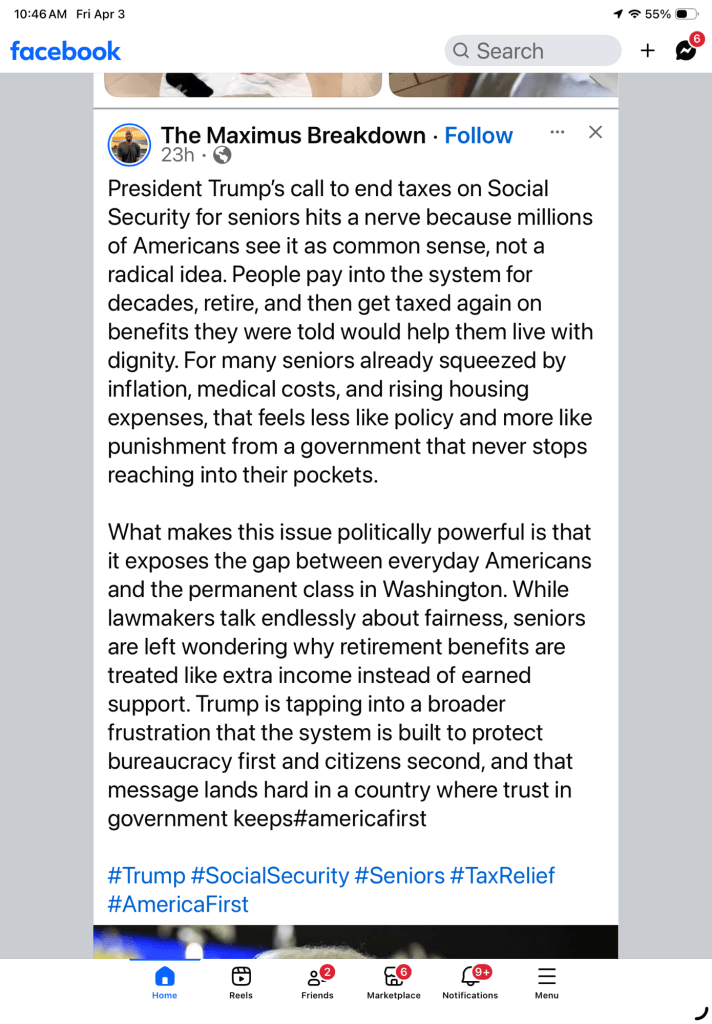
What Trump is tapping into is widespread ignorance. Of course, the “no tax” deal is already done, which, of course, is not what it claims to be.
- Most Social Security is not taxed and even when it is counted as taxable income no tax may actually be pay
- People pay taxes into Social Security, not toward their own account or ultimate benefits
- Many Social Security beneficiaries like nonworking spouses, ex-spouses, surviving spouses and children and people disabled from birth never pay a penny in Social Security taxes. That’s why it’s insurance.
- What people pay into the system has nothing to do with the benefits they receive.
- The great majority of recipients receive an amount in benefits exceeding what they paid in taxes within six years of beginning SS benefits. Many also receive an amount also exceeding their employer taxes as well.

 QUINNSCOMMENTARY
Agree that a portion of Social Security benefits should be taxed, but, long ago decided that the method Congress chose in 1983 was stupid. And, because of that, it gives the idiot ass Trump a talking point.
My recommendation:
Eliminate the $25,000 / $32,000 income exclusions, phase out.
Identify the amount of taxes/contributions individuals actually paid into the system – to the penny.
Highlight the amount in annual communications, showing the current year AND the cumulative lifetime amounts, where those contributions were paid after tax.
Refund, or distribute those monies first. Annually report the return of those monies – not treated as income for federal income taxes. Most states use federal Adjusted Gross Income, so, the refund of previously taxed monies will avoid state income taxes as well. Once those monies are exhausted, annually report as tax free benefits any current year contributions which were paid after tax.
Separately, in the annual communications, show the current year AND the cumulative lifetime amount of employer contributions. Note that employer contributions were tax deductible. And, like an employer contribution to a retirement plan, because it was a tax deductible amount, the benefit to the individual will be taxable income once received.
Once the employee after tax contributions have been exhausted, payout those employer contributions. Once all past employer contributions have been distributed, annually report as taxable any current year contributions where the employer took a tax deduction and the income should be treated as taxable income – same as an employer contribution to a pension plan.
Separate rules for SECA – self-employed.
Any additional benefits would be taxable as neither the individual nor their employer paid taxes on those monies in the past.
This would also provide newfound appreciation for the income transfer and investment/trust fund processes, transfers from current and past workers to current retirees.
With respect to your comments/justification:
Most Social Security is not taxed. Yes, for those who file a single return, because the average monthly benefit is now $2,076 or so – just barely below the $25,000 threshold. The median is closer to $1,800.
Even when it is counted as taxable income no tax may actually be paid. But, because the thresholds haven’t been indexed for any inflation since 1983, soon even those at the average will be subject to income taxation, as will those who have a spouse’s benefitand many joint filers.
People pay taxes into Social Security, not toward their own account or ultimate benefits. Agree, however, Congress has affirmatively lied to Americans about this claiming that the benefits were earned by their taxes/contributions.
Many Social Security beneficiaries like nonworking spouses, ex-spouses, surviving spouses and children and people disabled from birth never pay a penny in Social Security taxes. Agree, however, since women entered the workforce in great numbers in the 1970’s, that is less and less every year.
That’s why it’s insurance. Only if you put “insurance” in quotes. There is no risk transfer here – from individuals to an entity. As you and I have both confirmed, we all remain responsible/liable for any funding shortfalls, and may experience cuts in benefits or increased taxes or both.
What people pay into the system has nothing to do with the benefits they receive. Once more, with vigor, agree, however, Congress has affirmatively lied to Americans about this claiming that the benefits were earned by their taxes/contributions.
The great majority of recipients receive an amount in benefits exceeding what they paid in taxes within six years of beginning SS benefits. Use my method, and confirm that! Increases the perceived value of Social Security and clears up any misgivings about subjecting benefits to taxation.
Many also receive an amount also exceeding their employer taxes as well. Use my method, and confirm that! Increases the perceived value of Social Security and clears up any misgivings about subjecting benefits to taxation.
Once you confirm all of this with specific information, and annually update it, you silence the idiot ass Trump (and the lying Republicans and Democrats in Congress).
LikeLike