
In the interest of full disclosure, for the last fifty years I have done everything from process health insurance claims to design and manage health benefit plans to negotiate provider contracts and run HMOs, so when I say the choices offered in the marketplace are confusing to the average person … trust me.
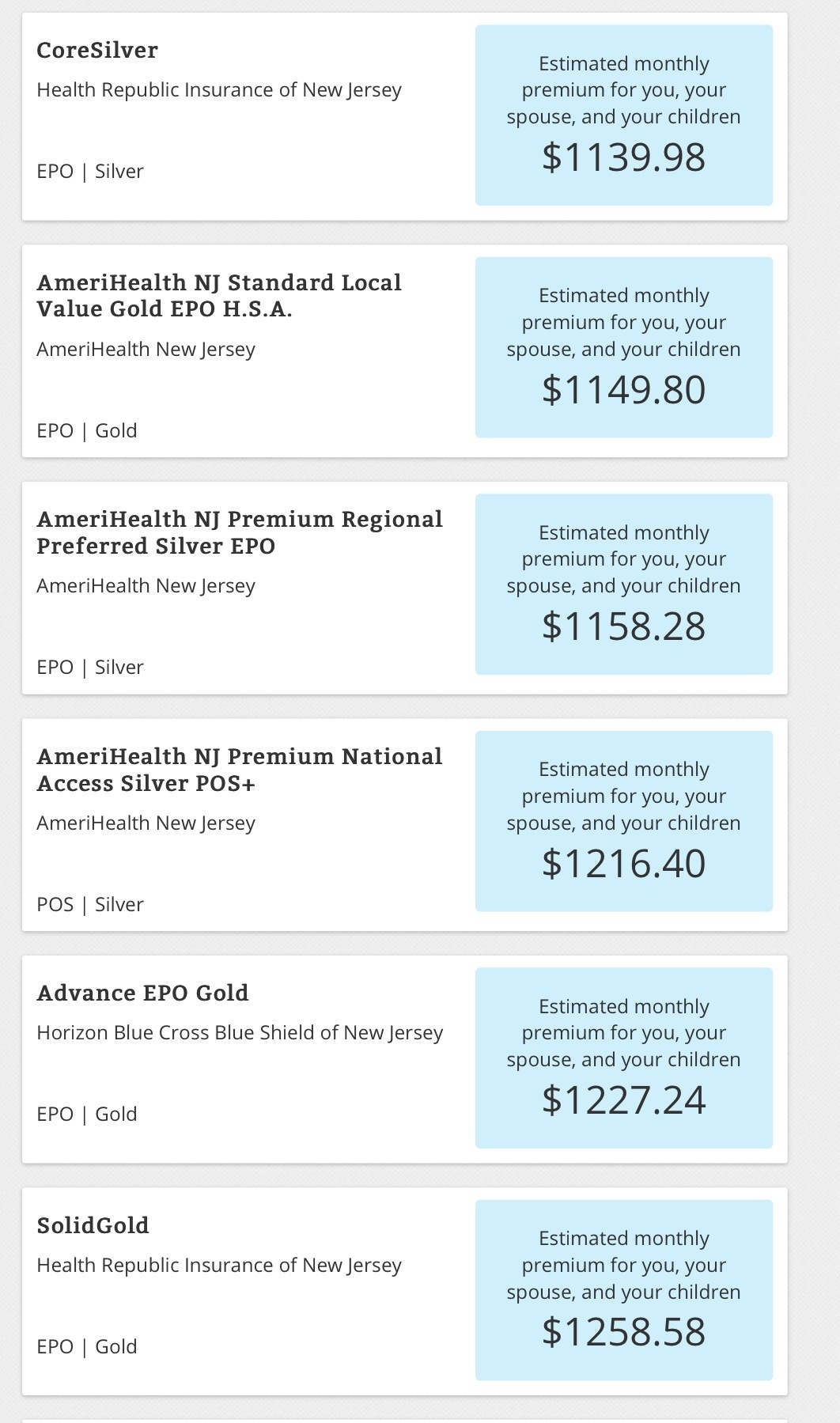
Here is a sample of plans in the New Jersey marketplace. Healthcare.gov has been quietly modified to allow you to see the plans before you actually open an account (a feature that should have been there from the start). It’s not easy to find, but it’s there.
Do you know what an EPO is? Is it a bit confusing that different levels and types of plans rather than being organized are presented in a mix?
Look at these plans and their prices and especially look at the prices of the plans offered by Health Republic of New Jersey. Do you see much difference in the prices between this plan and the others? Look at the first two in the list, both are EPOs (Exclusive Provider Organizations meaning very limited networks). Or as healthcare.gov says:
DEFINITION
Exclusive Provider Organization (EPO) Plan
… A managed care plan where services are covered only if you go to doctors,
specialists, or hospitals in the plan’s network (except in an emergency). …
The first is a silver level plan and the second a gold level meaning lower out-of-pocket costs and yet there is only a $10 monthly difference in premium. The last two are gold level EPOs yet the Health Republic of New Jersey plan is $30 more.
Now here’s the good part. Remember all the talk of insurance company profits, we need competition and such, well now that you have seen the results, you should know this about Health Republic of New Jersey:
We are Health Republic Insurance of New Jersey – a non-profit Consumer Operated and Oriented Plan (CO-OP) established through the Affordable Care Act. We provide cost-effective & comprehensive healthcare coverage to the people of New Jersey.
It would appear the reality of health care costs does not stop at the door of “non-profit” consumer operated plans. What is spent on health care is what matters . . . period!


http://thehill.com/blogs/healthwatch/health-reform-implementation/328459-labor-gets-obamacare-olive-branch- This hit the news this afternoon. Delaying the reinsurance fee for a year? I don’t see how the Obamacare marketplaces can survive without a reinsurance subsidy. They’ve already priced their plans.
LikeLike
It’s a real joke isn’t it? On one hand HHS says the reinsurance is lowering premiums by 10-15% and then it simply gets thrown out the window after all the 2014 premiums are set in the marketplace. I’m glad I am not an insurance company playing with the politicians.
Dick
Richard D Quinn
Blog http://www.quinnscommentary.com Twitter @quinnscomments
>
LikeLike
Dick,
For the record, my wife’s COBRA tab just got a (9% uptick for 2114). So much for obummercare lowering costs. I feel particularly bad about those folks at the lower end of the income scale who in spite of the governments donation will still have higher insurance premiums. Except those of course, who did not have any coverage and illegals who should not be covered but will at everyone else’s expense.
LikeLike
Good point about non profits. And here’s one of the little secrets that the press has never told you about Massachusetts in its slobbering over how much the rest of the country is soon going to be great, just like Massachusetts when it comes to health care insurance.
Massachusetts’ entire system used to almost totally non profit:
— insurers (not counting those who worked for a big corporation based elsewhere that used Aetna or Cigna or…) and
— hospitals and clinics (not counting doctors of course)
Since RomneyCare, the largest non-profit hospital chain has been bought out by a for-profit venture capital firm and many other non-profit community hospitals have been bought out by the largest non-profit hospital, bringing its Boston-teaching-hospital cost structure to the little towns around the state. And Governor Deval Patrick brought in for-profit Centene insurance from Missouri to be the first (and so far only) for-profit insurer on the exchange. Within a year or two, the head of the exchange left the Patrick administration and took a million-dollar-a-year CEO job as head of the Massachusetts Centene subsidiary.
LikeLike