
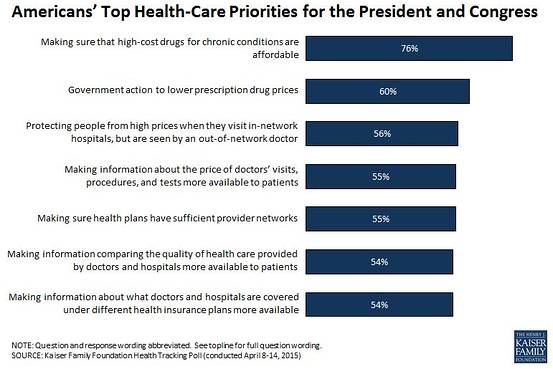
Here are the results of an interesting survey from the Kaiser Foundation. Notably the top priorities are nothing new and have little to do with the Affordable Care Act.
The issues regarding prescription drugs have been around for years. In some ways these complaints reflect the utility syndrome. That is, people complain about their high electric bill, but discount their increased use of the product. The same is true for medication. Americans love their quick fix through an Rx and all the drug advertising doesn’t help. Now that’s an area where government can do something just as it did with tobacco advertising. Drug companies wouldn’t be spending $3 billion plus on advertising each year if it didn’t work to increase sales. In addition, even those with prescription drug coverage are seeing higher co-payments.
The issues related to in and out of network providers is a long-standing dilemma that pits choice against cost management. The Affordable Care Act exchange plans made this issue more visible because of limited networks.
The quality issue is a tough one. Wouldn’t we all like to be treated only by the top quality providers? Quality information such as it is, is available, but it still doesn’t tell us much. How do you define quality health care?
The network participation issue is difficult to solve (which is one reason I believe we should eliminate networks). Participation information is generally available from a variety of sources, but patients may not seek it out. In addition, networks change frequently so updating is a problem.
The partisan breakdown beneath the aggregate polling data suggests a more nuanced story. Again, lowering the cost of drugs for chronic conditions was No. 1, but ACA-related priorities were closer to the top of the list for partisans. Democrats’ second and third priorities were requiring all states to expand Medicaid and expanding financial assistance to help people purchase insurance under the ACA, picked by 74% and 72% respectively. Democratic support for these items drove total public support for them to 50%. Repealing the ACA or its individual mandate came in second and third for Republicans, chosen by 60% and 52% respectively. The relatively high ranking of these issues for Republicans pretty much guarantees that the health-care law will continue to be a topic for GOP candidates in the 2016 primary season, though with all of them talking about it, candidates will face a challenge to differentiate themselves from one another.
via Americans’ Health Priorities Diverge From Washington’s Focus on Obamacare – Washington Wire – WSJ.


