
But more important we are not funding what we need to fund. We are misled about taxes (Americans think they are overtaxed).
We simply don’t want to pay for what we want and need.
The U.S. today carries roughly $35 trillion in national debt, is running an annual deficit of about $1.8 trillion, and is paying over $1 trillion per year in interest—now one of the largest items in the federal budget.

And in this fiscal environment, we lowered taxes‼️
The tax‑to‑GDP ratio is the percentage of a country’s total economic output (GDP) that the government collects in taxes. It shows how much fiscal capacity a government has and how heavy or light the tax burden is relative to the size of the economy.
📘 What the Tax‑to‑GDP Ratio Measures
- Tax revenue — all taxes collected (income, corporate, sales/VAT, property, payroll, etc.).
- GDP — the total value of goods and services produced in the economy
A country with $500B in tax revenue and $2T GDP has a 25% tax‑to‑GDP ratio.
🌍 Why It Matters
- Fiscal capacity — Higher ratios mean governments can fund services like infrastructure, healthcare, and education. Quickonomics
- Economic health — Shows whether tax systems are efficient and sustainable.
- International comparison — Developed nations typically have higher ratios due to stronger tax systems.
🌐 Typical Ranges
Country Type Typical Tax‑to‑GDP Ratio Interpretation
Developing nations 15%–25% Lower capacity, narrower tax base.
Developed nations 25%–40% Broader tax base, stronger administration.
Very high‑tax economies 40%+ Large welfare states (e.g., Scandinavia).
🧭 How to Interpret the Ratio
- Higher ratio → stronger government revenue, but potentially heavier tax burden.
- Lower ratio → lighter tax burden, but may indicate underfunded public services.
📊 Why Ratios Change Over Time
- Expansion of welfare programs (historically raised ratios in developed nations).
- Economic growth or recession.
- Tax reforms, subsidies, or credits that alter net revenue.
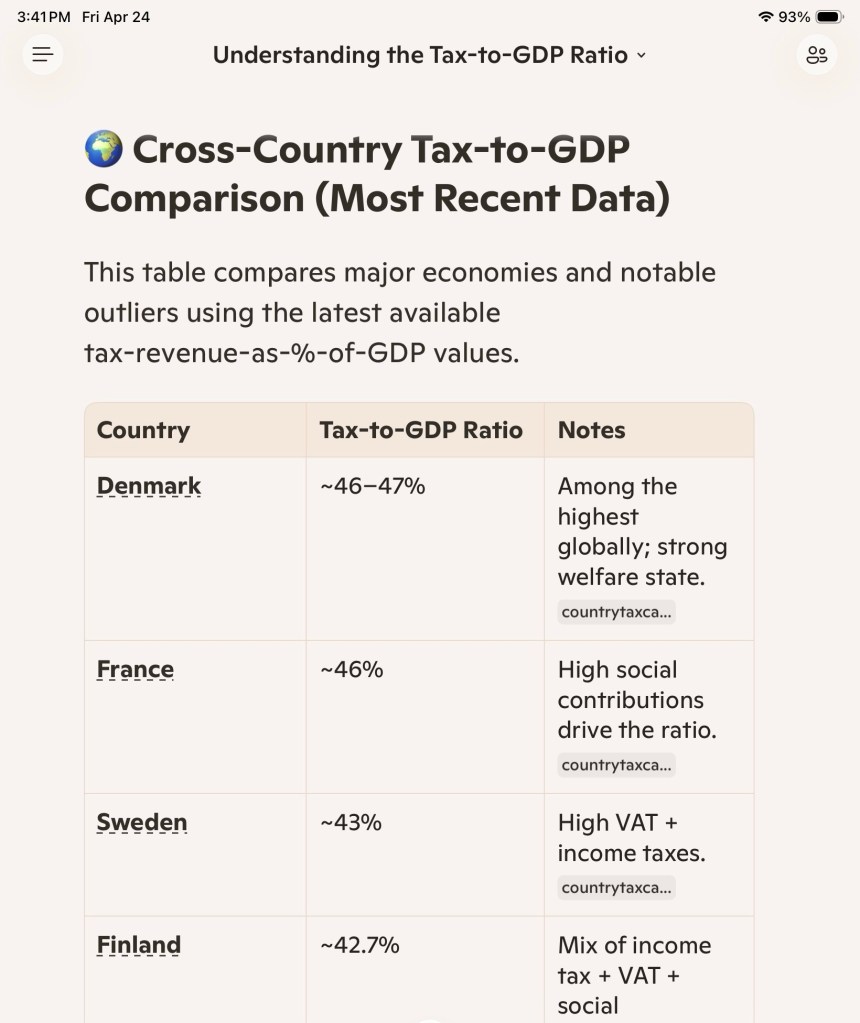
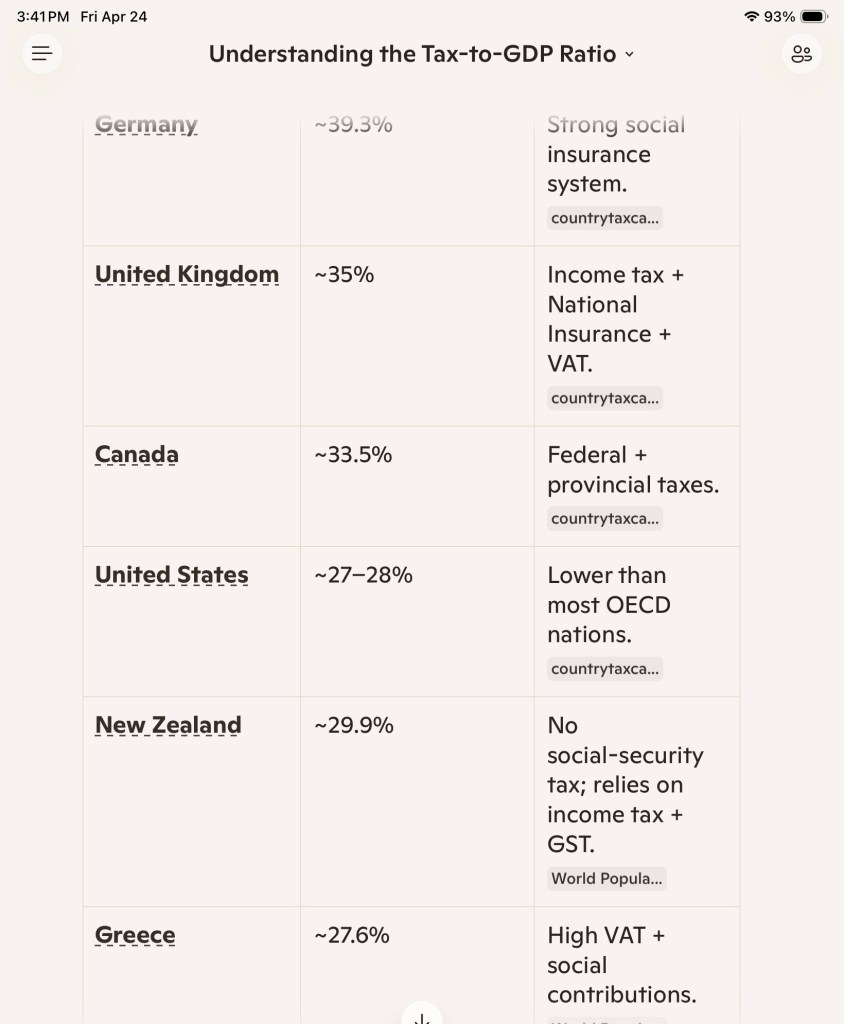
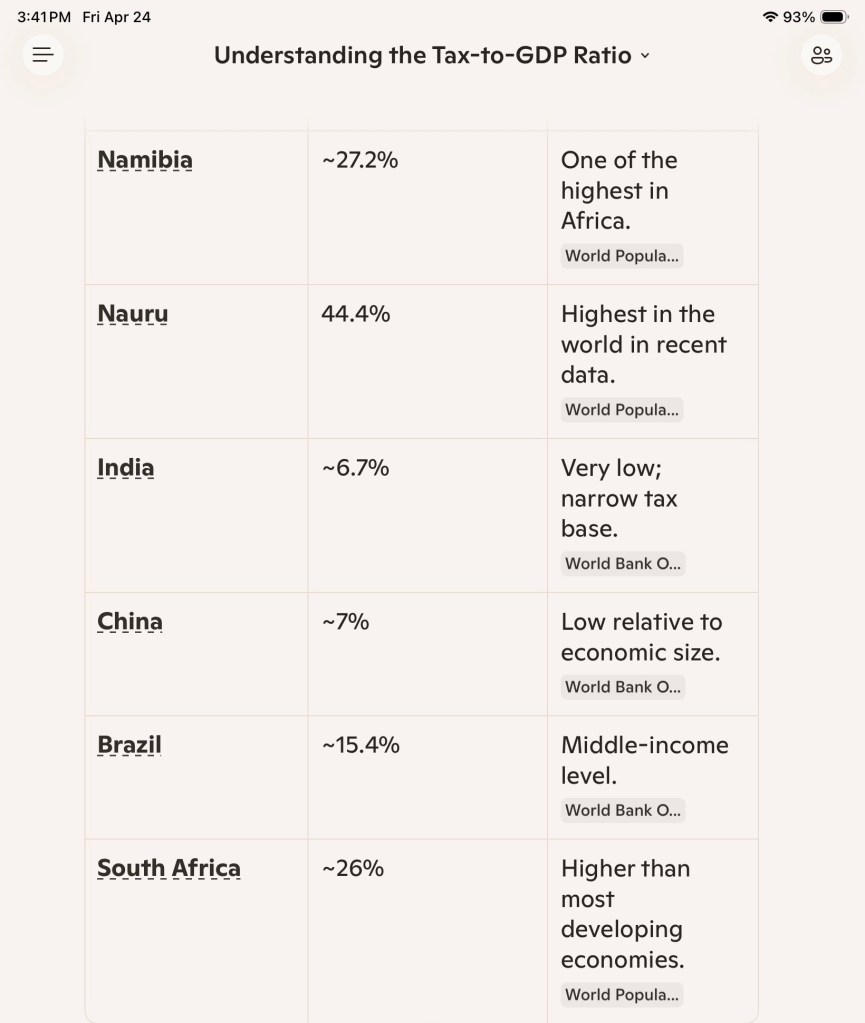
It all boils down to this in simple terms. Individuals can worry about and attempt to pay for things like child care, health care, college education, family leave, long-term care, etc. or society can ease those burdens and collectively fund them.

You pay as individuals or do without or you pay taxes and everyone is treated equally. It’s not socialism, but it is strong collective social responsibility.
Look at it this way, if we eliminated Social Security, would every worker use the new income to prudently save and invest for their entire working lives and always come out better, regardless of life’s misfortune along the way, than they will by paying FICA taxes?
And in old age what happens to the people who don’t?


My Dad said in a capitalist country, or a ‘free’ country, if a man/woman works harder/smarter, he gets to keep the gains of his labor.
“But its hard to believe a man can work 10,000 times harder than I (farm worker) do.” For whatever reason, there is an imbalance of income/wealth in the U.S. Much more imbalanced than most ‘developed’ countries.
I doubt if the poorest in France are paying 46%. And the richest are paying far more than 46%.
I am sure I pay (gladly) a higher percentage than most of my sisters, and that Richard and BenefitJack pay a higher percentage than I do. Gladly?
LikeLike
If a person does a job and expects that raises in the job over the years will allow them to get ahead, they will be disappointed. They will merely keep up with inflation, if lucky.
The key is not working harder, but smarter. Moving up, taking risk, learning new things, creating, fiscal responsibility, always investing even small amounts. Nobody handed the wealthy what they have. Even if inherited, somebody originally created the wealth.
LikeLike
I pay what I owe. I am in my 58th year of wage employment. I am in my 5th year of Social Security payout and Medicare Part A, B and D coverage. I have paid IRMAA in some good years, but not this year. I and my spouse have caused to be contributed far in excess of what we will ever receive – once you adjust for our contributions, those of our employer, and, a modest rate of return that would have been possible (even after subtracting for the value of disability and survivor coverage).
Bottom line, I would not mind paying more than I will ever receive – but only if the idiots in Congress had long ago stopped buying votes. Even though I have paid more, much more than I will receive, I expect any solution by the criminal class in Congress to Social Security funding woes, will be a cut to my benefits and an increase in my taxes – I will be among the first in line for both.
LikeLike
The comparison to other developed countries doesn’t prove we are over or under taxed. You are assuming that the higher taxed countries are the standard we should measure against. Those countries could be over taxed. No?
The problem here is we don’t collect enough or cut enough to cover the deficit or tax enough to make the deficit much less daunting. If you are going to add more government supplied benefits then you will need a tremendous amount of tax revenue to cover that in addition to the increase for the present day deficit.
It costs a lot to join in with the highly taxed countries.
LikeLike
We are not overtaxed. It’s that simple. We don’t even pay for the things we want and need and have had for decades. And we certainly don’t understand the relationship between taxes and what we receive in return. That is something most Europeans do understand and generally accept.
These days in America we are focused on smaller government, individual empowerment, keeping and better using our own money for important things like healthcare. That is a myth, human beings don’t act like that and far too many are just irresponsible, sad, but a fact. Always has been and always will be.
LikeLike
“We are not overtaxed. It’s that simple. We don’t even pay for the things we want and need and have had for decades. And we certainly don’t understand the relationship between taxes and what we receive in return.”
The problem is defining “”we”. Speak for yourself.
Some are overtaxed – typically high income wage earners are overtaxed. They bear a disproportionate amount of the burden assessed today – far beyond what most Public Finance texts would suggest is an appropriate level for progressive taxation. That is, most Public Finance texts would suggest that economic growth would be improved if we reduced the burden on productive Americans. See Kennedy, Reagan, Bush II, and yes, even the idiot Trump initiatives.
Some do pay more, much more than what is necessary for the things they want and need, and receive.
And, some do understand the relationship between taxes and what they receive in return – recognizing that they are paying much much much more in taxes than they will ever receive in return.
The problem is the “we” comprised of the ~47% mentioned by some politicians who want the other “we”, the 53%, to provide more. The problem is that our idiot government representatives have learned that they can provide whatever will buy votes, without having to raise current taxes, but can deficit spend and send the bill to generations of Americans too young to vote and generations yet unborn.
We don’t have a tax issue. We have a spend issue.
Suggesting that other countries tax more because they spend more is an appropriate comparison to America just ends up as an attempt to justify progressive/liberal support for Congressional spending malfeasance … ongoing since 1969 (with perhaps the exception of 1998 – 2001).
LikeLike
it is precisely because we are supposed to be a limited federal government that results in our GDP and economic growth. Only someone who doesn’t understand macro economics would suggest that the relationship of federal spending and revenues in other countries is an indicator of what is appropriate or optimal for America.
LikeLike
The topic was relative taxation. The point being we are not a high taxed country. A limited government that spends $1.8 trillion more than its revenue from all sources.
That’s like saying a family with $20,000 in credit card debt and making minimum payments at 18% is living within its means.
LikeLike
No. We do not have a tax problem. We DO have a spending problem. The solution is not to tax more, but to reduce spending to match our federal government of “limited powers.”
LikeLike