
the risks far outweigh the potential benefits. It’s a very bad idea.
Politics is the greatest risk
Investing the Social Security Trust Funds in stocks instead of mostly U.S. Treasury bonds has some potential advantages (higher long-term returns), but there are also significant downsides and risks that critics emphasize:
- Market risk and volatility
Stock markets can fall sharply for years at a time. If the trust fund needed to pay retirees during a downturn, losses could force benefit cuts, higher taxes, or emergency borrowing. Treasury bonds are far more stable. - Political pressure and government influence
If the federal government became one of the world’s largest stockholders, there would be concerns about political influence over private companies:
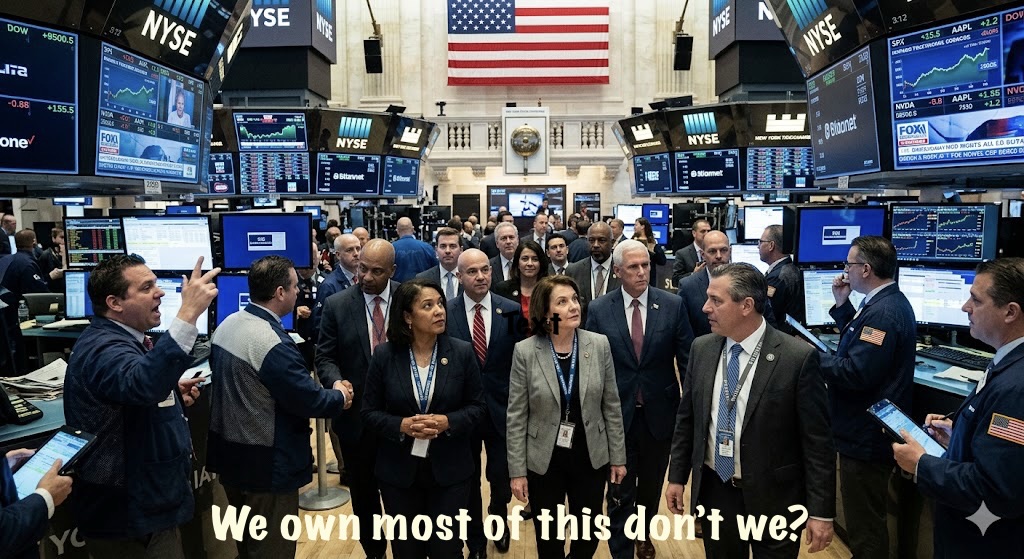
- Pressure to favor “politically desirable” firms or industries
- Debates over voting rights for shares
- Accusations of government interference in capitalism
- Timing risk
Social Security’s demographic problem is partly near-term: many retirees are already drawing benefits. Stocks tend to outperform over decades, but poor returns during critical years could worsen funding gaps. - Public backlash during crashes
Imagine retirees hearing that Social Security lost hundreds of billions during a bear market. Even if losses were temporary, confidence in the system could collapse politically. - Ethical and governance disputes
Questions would arise about:
- Should Social Security invest in oil, tobacco, defense, or foreign firms?
- Who decides the investment strategy?
- Should it track an index or pick stocks?
Those debates could become highly politicized.
- Transition risk
The trust fund currently holds special Treasury securities. Moving substantial assets into equities could temporarily affect:
- Bond markets
- Interest rates
- Stock valuations
Because the fund is enormous, reallocating trillions of dollars is not simple.
- “Higher returns are not guaranteed”
Historically, stocks outperform bonds over long periods, but that is not certain. Japan’s stock market, for example, took decades to recover from its 1989 peak. Critics argue Social Security should prioritize reliability over maximizing return. - Moral hazard and expectation creep
Once tied to market performance, politicians might:
- Promise higher benefits during bull markets
- Face pressure for bailouts during crashes
- Encourage excessive risk-taking to close funding gaps
- Intergenerational fairness concerns
A generation retiring after a market crash could receive less effective support than one retiring after a boom, making outcomes less predictable and potentially less fair.
Supporters of stock investing usually counter that:
- Long-term diversified equity investing historically beats bonds
- Other public pension funds already invest heavily in stocks
- Even partial equity exposure could improve Social Security’s finances
So the debate is mainly about balancing:
- higher expected returns
versus - stability, political independence, and guaranteed benefit reliability.


Social Security was created because of AND in the (long) wake of the biggest stock market crash in history. THIS idea to invest the Social Security Trust in the very same thing that necessitated its creation is ludicrous, dangerous and ill-conceived.
LikeLiked by 1 person
Appreciate your view. America should have had this discussion long ago, where, when we were accumulating assets significantly greater than the current liabilities, we coulda/shoulda/woulda invest them long term – and not just an allocation to equities, but also in physical resources.
That was especially true for assets in the Medicare/HI Trust fund. That fund was only 20% of annual spending in 1993 (when President Clinton’s Administration/Congress made a mistake and removed the wage cap on FICA-Med taxes – dramatically increasing the progressivity of Medicare, a la Medicare B (and later Medicare C) which are funded by general revenues, primarily income taxes. Then President Obama, in Health Reform, added a surcharge on income (not wages subject to FICA taxes (IRC 3121(v)), which coupled with Medicaid, makes health care for retirees even more of a welfare program. Instead of a pay as you go change in 1993, which only raised trust revenues to 152% of annual spend in 2023, they should have acknowledged the coming retirements of Baby Boomers, and raised the 1.45%/2.9% rate to build up a surplus, and invest those assets long term in something other than increased federal government DEFICIT spending.
Hell, we could have followed through and acquired Greenland and made a better bid for Iceland as well.
For example, at the end of fiscal year 1946, the Social Security Old-Age and Survivors Insurance Trust Fund grew to $7.641 billion, driven by a $1.028 billion surplus of receipts over disbursements. Harry Truman offered $100 MM for the Island in 1946. Tactically, he might have made a pitch a year earlier, when the US was already defending the island and liberating Denmark from the Nazis.
More importantly, when successive Congress/Administrations were buying votes by improving benefits far in excess of their willingness to increase taxation, they should have considered restructuring the program (as some propose today) based on what are new (two) goals inherent in today’s structure (a social insurance program, and, a retirement benefit):
Your arguments work OK for the Social Security program as it was intended in 1935. Not so much for the program as it has been bastardized since 1939, ignoring various demographic and market changes over the past ~85 years.
LikeLiked by 1 person
You raise an interesting point about the missed opportunities to prepare for the demographic challenges we face today. Many experts have argued that policymakers should have taken a longer-term approach when trust fund revenues exceeded immediate obligations. However, any discussion about investing Social Security or Medicare funds in equities also comes with risks, including market volatility and political concerns over managing those investments.
What seems clear is that decades of delayed reforms have left fewer options and made the choices more difficult. Regardless of where people stand on the investment question, most would agree that lawmakers should focus on creating a sustainable system that protects current retirees while remaining viable for future generations.
LikeLike
Yes indeed.
LikeLike
There are always reasons to not change a current course of action and many questions are valid. I would point to the Federal Employees Thrift Savings Plan as an example that works well without all the attendant questions of potential political influence in the market. The funds are all indexed. The TSP has provided a robust retirement fund for participants.
Anyway, food for thought.
LikeLike
I don’t see that as a valid comparison. The thrift plan is individual accounts directed by participants, not politicians. SS is a massive fund totally in the hands of politicians.
LikeLike
You don’t trust politicians to put money in the S&P 500 fund but you will allow them to handle the cash coming in? Anyway, BenefitJack has touched on the key point. Time has run out to concern ourselves with where to put the revenue because it has hit the revolving door stage, money comes in and immediately goes back out. Social Security recipients want cash in hand every month. The time to deal with the stock market issue was back in the Clinton era when the surplus was building up.
What has to be faced now is what tax rate increase is palatable and what limit can be placed on future benefits. It won’t be pretty and there will be a lot of howling.
LikeLike