
Stolen? Greed? let’s consider facts.
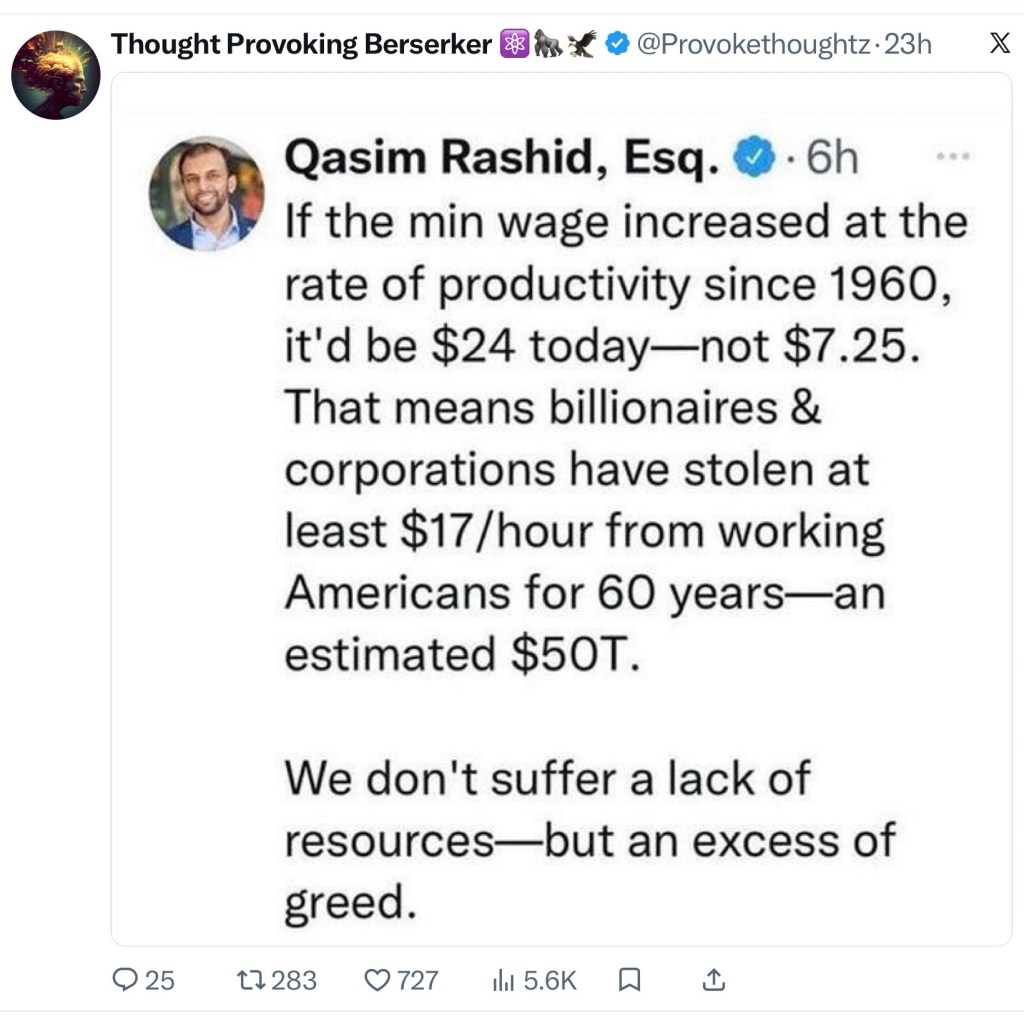
Very few workers actually earn the federal minimum wage of $7.25 per hour (unchanged since 2009). In recent years, only about 1% of hourly paid workers (roughly 800,000–1 million people) earn at or below this level, a sharp decline from 13.4% in 1979.
Key 2024 BLS Statistics
In 2024, among ~80.3 million hourly paid workers age 16+ (about 56% of all wage/salary workers):
• ~82,000 earned exactly $7.25/hour.
• ~760,000 earned below it (often due to exemptions like tipped wages, students, or certain disabled workers).
• Total at or below: ~843,000 (1.0% of hourly workers).
Similar figures held in 2023 (~1.1%).
Demographics and Characteristics
Minimum wage workers are disproportionately:
• Young: Workers under 25 are ~20% of hourly workers but ~43% of those at/below minimum. Teenagers (16–19) have rates around 2.6–3%, vs. ~0.7% for age 25+.
• Women: Slightly overrepresented (e.g., 1.3% of female hourly workers vs. 0.8% of males in 2024).
• Never-married: Higher rates due to younger average age.
• Part-time: Much higher likelihood (e.g., 2.4% vs. 0.6% for full-time).
• Education: Slightly higher among those without a high school diploma (~1.5–2%), but rates are similar (~1%) across other education levels.
Race/ethnicity: Percentages are similar across major groups (White, Black, Asian, Hispanic) at around 1%.
Industries and Occupations
• Leisure and hospitality (especially restaurants and food services): Highest concentration—~two-thirds of minimum wage workers; ~5–6% of hourly workers in this sector.
• Service occupations (mostly food prep/serving): Nearly 3/4 of minimum wage workers; tips often supplement base pay.
Many in these roles are entry-level or student workers. Note that data come from the Current Population Survey and reflect reported hourly wages (excluding tips/overtime); they do not distinguish full FLSA coverage or state/local minimums (30+ states + DC have higher minimums, so their workers earning the state minimum aren’t counted here as federal minimum earners).
In short, the federal minimum wage is primarily earned by young, part-time, entry-level workers (often in food service) rather than being a broad adult livelihood. Most low-wage work occurs above $7.25 due to market forces, state laws, experience, and tips. For the latest full tables, see the BLS annual reports.
30 states have minimum wages above $7.25. Some examples of higher rates (as of early/mid-2026) include Washington (~$17.13), New Jersey ($15.92), California (~$16.90), D.C. (~$17.95), New York (up to $17.00 in some areas), and Connecticut (~$16.94). Many states index increases to inflation or have scheduled future raises

There is no excess of greed and no income stolen. In fact, a minimum wage presents a job opportunity to many. However, the federal MW should adjust periodically.

 QUINNSCOMMENTARY
The federal minimum wage is a figure that doesn’t make much sense today. I think that’s why it hasn’t been adjusted for so many years. Regional minimums would be more appropriate but even that would not be all that helpful if you advertised a position and nobody would agree to work for the stated minimum. An employer must pay what a competent worker is willing to accept. I used to pass by a company that always had a large help wanted sign out front. I found out later that they paid something like $14 an hour for work on the plant floor and people would work for only a week or a few weeks before moving on and usually the vacancies stayed unfilled. A chance meeting with the manager who said he wished he could get approval to increase the starting pay.
LikeLike
“A chance meeting with the manager who said he wished he could get approval to increase the starting pay.”
I remember earning the minimum wage. And I remember being paid less than I was worth. However, those two times weren’t the same ones, the same job.
I probably wasn’t worth $1.30/hour in 1969 – in terms of my contribution to the retail department store at which I worked. It didn’t take them long to figure that out, and I was let go within 2 months.
On the other hand, when I was being paid multiples of America’s average wage 20+ years ago, I was significantly/dramatically underpaid compared to my contributions to the organization. Had I been paid based on demonstrated performance metrics, my wages would have been 3 – 4 times as high.
Your comment: “An employer must pay what a competent worker is willing to accept.” is spot on. However, most of us have been willing to accept wages that do not equate to our contributions, at one time or another in our lives, if only because wages are just one part of “total remuneration” – wages, benefits, personal development/growth, and a variety of other factors at work.
LikeLike