
If your employer helps pay for your health insurance, the value of that contribution (which can be very substantial) is tax-free to you. In addition, you may also be paying your share of the premium on a pre-tax basis making that contribution tax-free as well.
You may not ever think about this tax-free income; most people don’t. In fact, you likely don’t even think of the thousands of dollars in employer contributions as income at all.
On the other hand, Congress thinks about this provision of the tax code because it represents the single largest revenue loss to the government. The Congressional Budget Office (CBO) thinks about it too.
While it is clear that tax-free “income” costs the government revenue, the other effects of this benefit are misrepresented, but nonetheless will be influential in making changes in the future … changes coming from your wallet.
Here is one slide used in a recent CBO presentation:
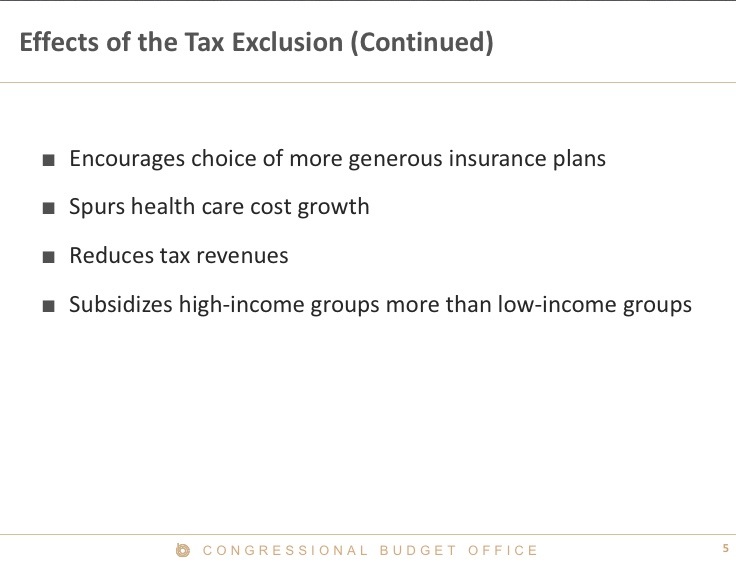
Look at the first two bullets. Do you choose a more costly, more generous health plan because you have calculated that what your employer pays is tax-free? Do you elect to buy a more costly plan because your contributions are pre-tax? I’m guessing (based on nearly fifty-years of experience) that those factors don’t even enter your mind when selecting a health plan. Because your premiums are pre-tax, do you spend more on health care? I bet you don’t even know what you pay in premiums each pay period and you may not even know they are pre-tax.
Do you think your employer intentionally offers a generous plan because of these tax benefits? More likely your employer has been trimming benefits, perhaps converted to a high deductible plan and has raised your premiums as well.
These implied affects of the tax treatment of health insurance premiums are misleading at best. No matter though, they will be used to set policy in the future.
As to the last bullet, what that is saying is that the greater percentage a person pays in income tax, the greater the benefit of tax-free benefits or deductions. That’s simple math, but so is saying the more a person earns, the more they pay in taxes and the larger percentage they pay. In addition, since the value of the benefit is not income related, the lower income workers receive greater value and a greater portion of their total income from the health benefit exclusion.

 QUINNSCOMMENTARY
Be careful when quoting the CBO. Tax free income does not cost the government revenue! The revenue belongs to the people who earned it, not the government. Shouldn’t a change in pre-tax premiums be called lost consumer spending power instead?
LikeLike
I don’t have to worry since my employer dropped retirees after age 65. Got a much better deal from AARP as my Supplimentary rather than what my employer provided. Wasn’t till Dick made me aware that they were not giving me a good deal anyway.
LikeLike
.
“… since the value of the benefit is not income related, the lower income workers receive
greater value and a greater portion of their total income from the health benefit exclusion. ”
This is why I think the government has not [yet] taxed employer funded health care benefits…
because it would hit lower income employees harder.
And what about all the retirees whose ex-employers still fund their health benefits ?
.
LikeLike
Yeah, including me. A reasonable adjustment would be limiting or gradually eliminating the Section 125 pre-tax premiums.
LikeLike