
Listen to old Liz Warren and all you hear is lower the student loan rate. Once again the progressive left ignores the real problem and focuses on the populist “solution.” As you can see below, loans aren’t the real problem, it’s how the loans are accumulated and misused that’s the real problem.
It’s like inequality. Instead of our obsession with the one-percent, we should be fixating on uplifting the bottom 40%.
Back to the point which is summarized well below.
Most College Students Don’t Graduate On Time
Graduating a year late can cost students nearly $70,000 in lost wages and school expenses.
By Allie Bidwell Dec 1, 2014
The vast majority of college students aren’t completing their degrees on time, largely due to a lack of guidance and too many choices.
A new report from the nonprofit Complete College America argues two-year and four-year degrees are “little more than modern myths” considering how few students actually finish their degrees in that amount of time.
“The reality is that our system of higher education costs too much, takes too long and graduates too few,” the report says. Source: USNEWS.com 12-1-14
 Look at the dropout rates; the graduation rate even within six years. It’s a joke. Keep in mind that old Bernie Sanders the socialist wants to have “free” college, yeah, that solves the problem; free college for people who are not prepared for college and can’t stick it out for success. At a time when government and employers are trying to change behavior for health care spending by encouraging higher deductibles to give people a stake in their spending the extreme left wants to make students less responsible for their education. Imagine what would happen to these numbers if all or most of college was “free” or if student loans carried such low subsidized interest so that borrowing more was easier.
Nationwide, only 50 of more than 580 public four-year institutions graduate a majority of their full-time students on time. Some of the causes of slow student progress, the report said, are inability to register for required courses, credits lost in transfer and remediation sequences that do not work. The report also said some students take too few credits per semester to finish on time. The problem is even worse at community colleges, where 5 percent of full-time students earned an associate degree within two years, and 15.9 percent earned a one to two-year certificate on time.
The lengthy time to graduate has become so much the status quo that education policy experts now routinely use benchmarks of six years to earn a bachelor’s degree and three years for an associate degree.
“Using these metrics may improve the numbers, but it is costing students and their parents billions of extra dollars — $15,933 more in cost of attendance for every extra year of a public two-year college and $22,826 for every extra year at a public four-year college,” the report said. “Hands down, our best strategy to make college more affordable and a sure way to boost graduation rates over all is to ensure that many more students graduate on time.”
Each year, the report said, 1.7 million students begin college in remediation, including a majority of community college students — but only one in 10 remedial students ever graduate.
Also, 60 percent of bachelor’s degree recipients change colleges, with almost half of them losing some of their credits when they transfer. Source: New York Times December 1, 2014
Student graduation is pathetic.
In order to accomplish President Obama’s American Graduation Initiative, which has a goal that “by 2020, this nation will once again have the highest proportion of college graduates in the world,” the United States must focus on both entry into and completion of postsecondary education. The U.S. has made moderate progress towards increasing college entry over the past four decades; the number of students enrolled in postsecondary institutions has more than doubled to 21 million students. However, the U.S. lags behind other nations in terms of college completions. The percentage of full-time students at four-year institutions who complete a bachelor’s degree in four years is only 37.9%, and the completion rate after six years is only 58.3%. Source: http://www.air.org/sites/default/files/downloads/report/AIR-CALDER-Understanding-the-College-Dropout-Population-Jan14.pdf
Many and in some cases most of college bound students are not even prepared for college. I suggest that even if they eventually graduate, the degree has little value just as their high school education was apparently inadequate.
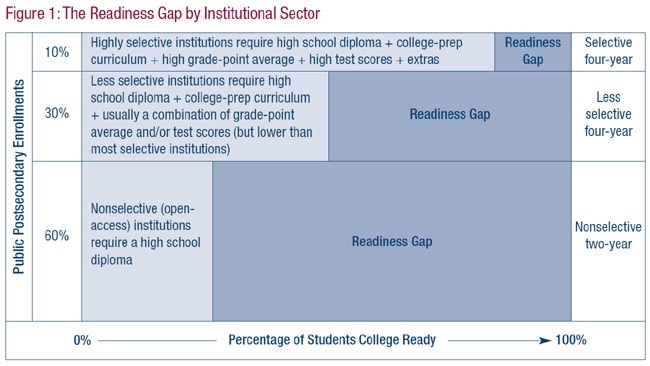
Figure 1 below shows the extent of the college readiness problem by portraying the gap between eligibility for college and readiness to do college-level work. Students in public colleges and universities attend one of three types of postsecondary institutions: highly selective four-year institutions, somewhat selective four-year institutions, and nonselective or open-access two-year colleges. The readiness gap is nominal in the most selective universities because their admissions criteria screen out most students who are underprepared. The gap is huge, however, in the other two sectors of higher education, which serve between 80% and 90% of undergraduates in public institutions. Source: highereducation.org

 QUINNSCOMMENTARY
Walk into a very expensive restaurant, before ordering you food, arrange with the restaurant loan officer the payment terms of the bill with attractive rates and a decade long schedule. Order your food, enjoy the many appetizers, sample the several entrees, imbibe a variety of beverages, and end with a sample tray of desserts. A week later, when the first bill arrives, react appropriately, stamp your feet, jump up and down, and scream that the below market interest rate is still more than you can afford.
LikeLike
Very good 😀
LikeLike
It took me 29 years to complete my degree because I had to work fulltime and then I finished with an online program that had only 2 weeks a year of no classes (Christmas break). My brother went to Drexel and because of the internships it was a 5 year program from the start. Both of us ran into “required classes” that were not always offered. Colleges need to offer the classes and get more class time in during the year (think all year long). It may not lower college tuition but could shorten the time and thus the student cost of trying to live another year without a good fulltime job.
LikeLike
In other words colleges need to get organized and actually care about their costs and how they are incurred😒
LikeLike