
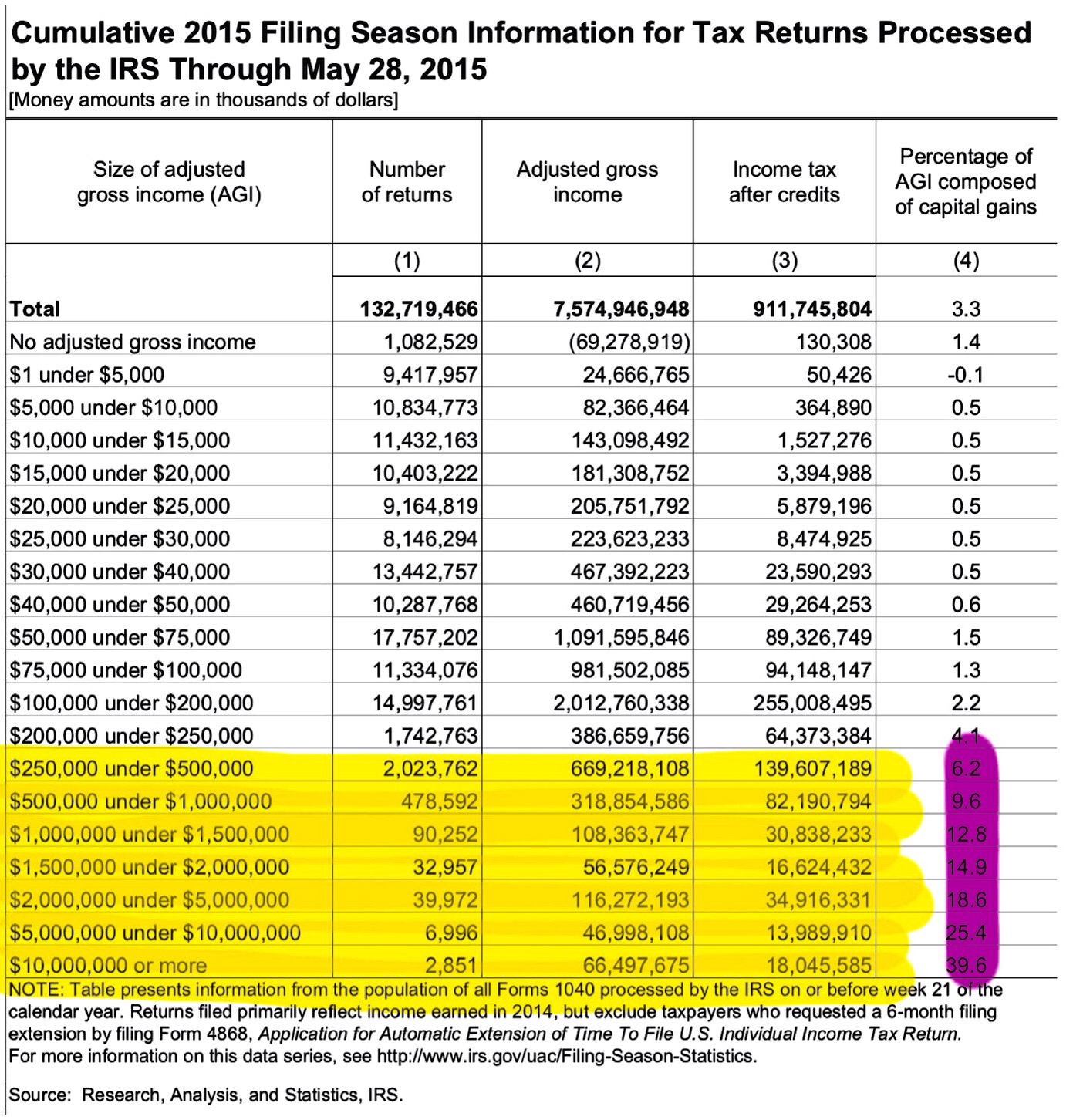
Following is the latest income and tax data from IRS filed tax returns. I suppose based on your point of view you can draw whatever conclusion you seek.
However:
- The wealthy (income of $250,000 or more) in fact pay 36.8% % of all income taxes
- The wealthy earn a disproportionate amount of their income from capital gains – various investments (which is taxed at a lower level than other salary or wage income).
- The wealthy represent two percent of all taxpayers
- While theses data exclude federal tax credits, they do not reflect non-taxable income in the form of state and federal benefits received by low income individuals
So, in light of the rhetoric on inequality, do you believe that two percent of Americans who overwhelmingly earned their income and wealth are taking something from you and otherwise blocking your opportunities?

 QUINNSCOMMENTARY
History does repeat itself.
Forty or so years ago, the baby boomers were being told that they should aspire to and save up for their part of the “American Dream” – and were criticized by some in the greatest generation for “wanting it all now, today”, Back then, I would note, nothing wrong with wants you are willing to work for.
While we are repeating the wants, what’s different is the perception among younger individuals, fostered by Bernie, Barack, Hillary and others, that no matter how hard you work, few will succeed in achieving their aspirations – that those at the top will ultimately block your progress. Of course, that is absurd – if anything, people truly at the top, Bill Gates, Steve Jobs, Jack Ma, and others have freed up resources/capability through innovations even Thomas Edison and Jules Verne could never have even dreamt about.
That said, what is really troubling about the data you show is what’s missing. The data show 132MM individual/joint filers of a tax return. What’s missing are the incomes and taxes of the 100+MM working age Americans who are NOT WORKING. For every 3 people who became part of the working age population last year, only one new job (1.07) was created. That is, even if the highly touted unemployment rate went to 0%, we would still have over 1/3 of all working age Americans unemployed – not actively working. It is particularly troubling to see the workforce participation rates among younger Americans – used to foment the 1%/99% stupidity. The largest reduction in the workforce has been among the millennials – the labor force participation rate for those 16 – 24 is 55.1% – versus 60.8% 10 years ago, 66% at the turn of the century. For younger Americans, our economy looks a lot like Greece or Spain where up to 50% of younger people are not working.
Why is that? As one looking for employment today, it seems there are jobs and careers available … but there is some sort of a reluctance among employers to actually hire. It must be, in part, the result of all of the layers of regulatory burden that come with employees … health coverage, employment discrimination, environmental regulations, disability accommodation, etc. Each of us wants those protections, but, few can calculate the cost/impact on economic growth.
It begs the question … what policies are truly holding us down, triggering a stunted recovery/economic growth rate of < 2% since the 2008-2009 recession ended in June 2009? Why do US firms like Towers Watson get sucked up by firms like Willis (headquartered in London, tax situs in Ireland) – is it bad tax policy? And, how does that affect US employment? Some at the Wall Street Journal suggest such tax inversions may actually favorably impact US employment, by reducing the taxes paid on foreign source income. I really don't know, but, until more Americans are working, I am less concerned about the distribution of the tax burden among taxpayers for funding our government, than I am about expanding the base of those who should be funding our government.
LikeLike
You raise very valid points and interesting questions. The participation rate is especially troublesome and largely ignored.
LikeLike