
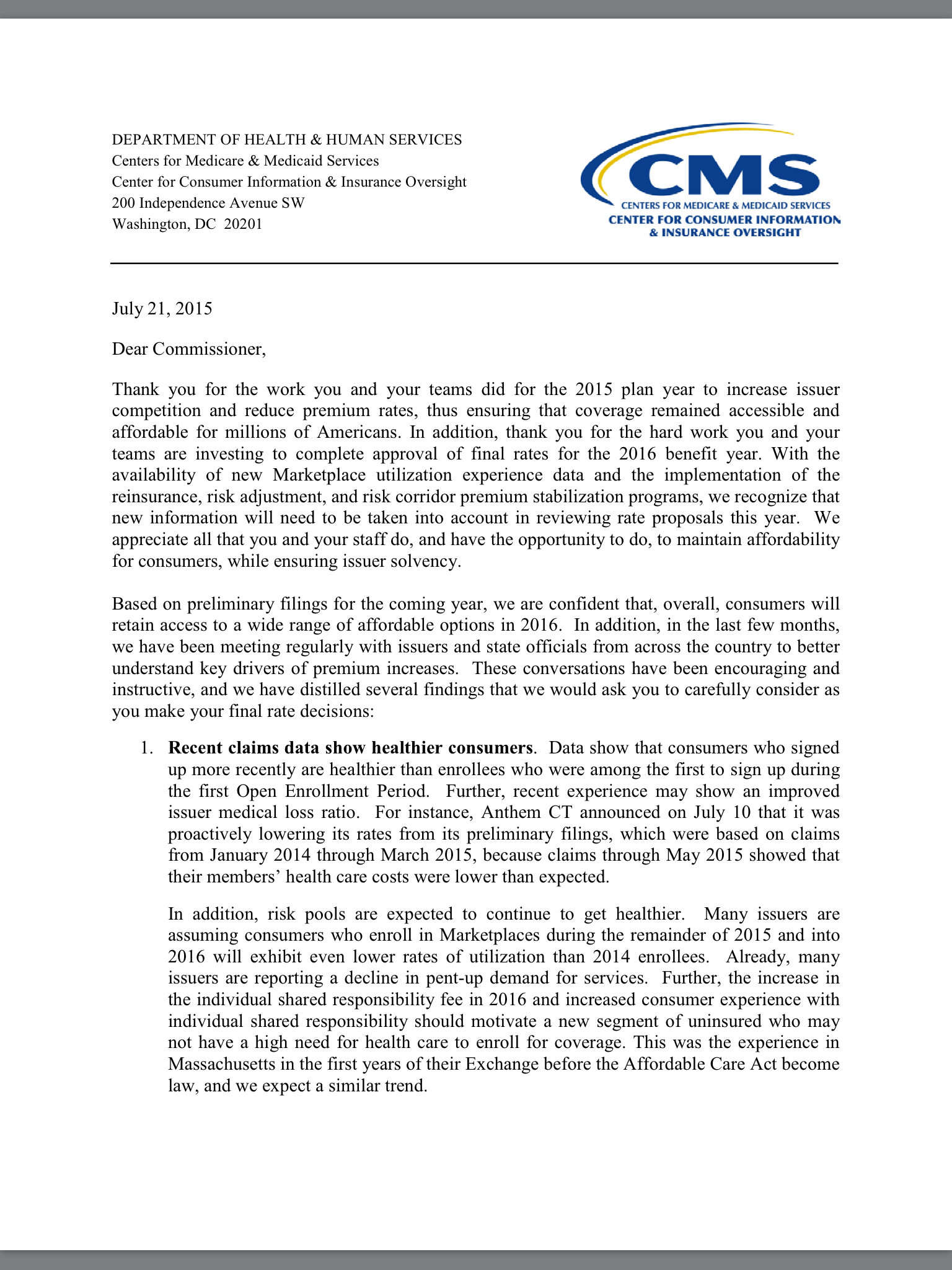
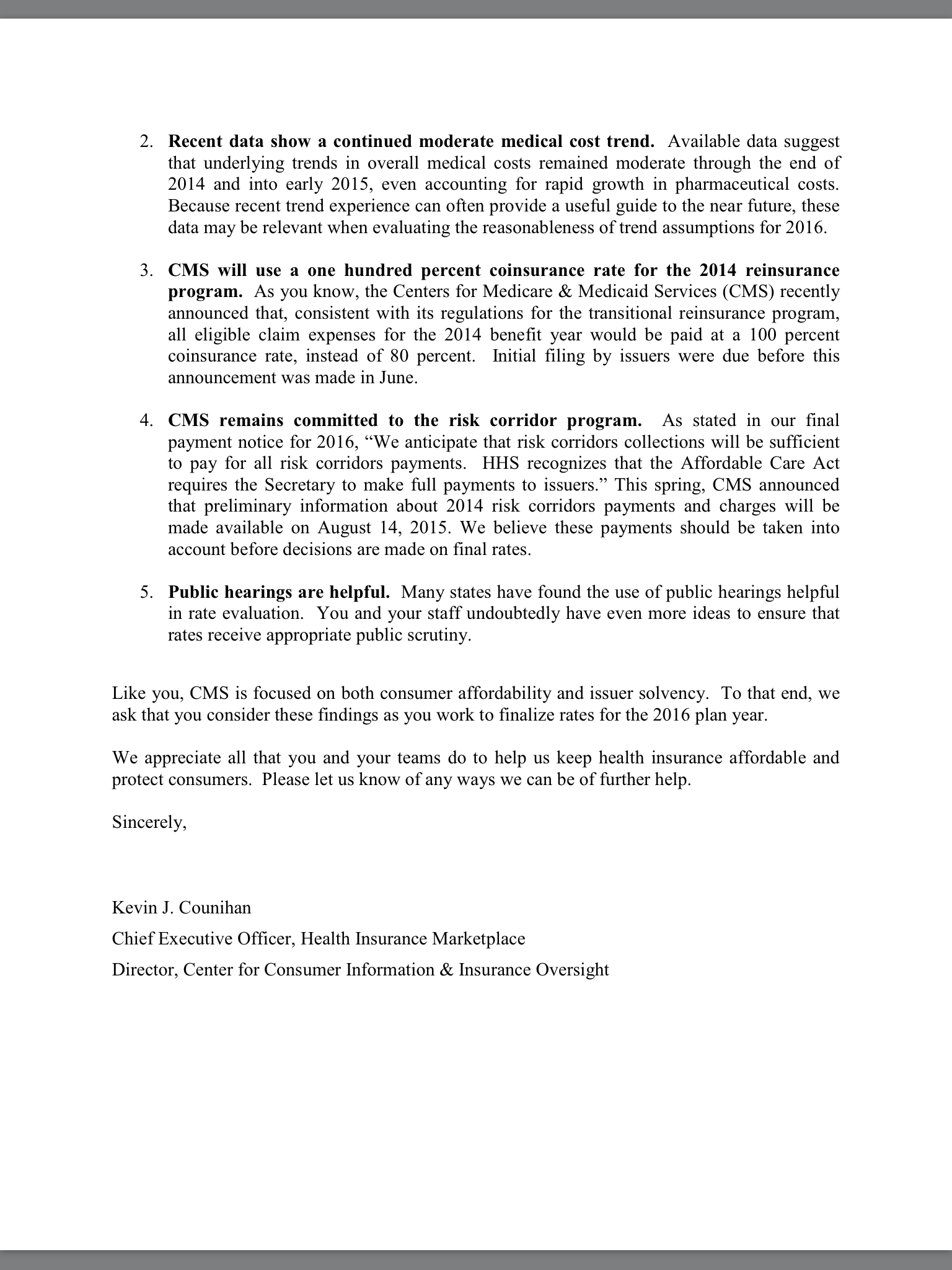
Recently, the CEO for the Obamacare marketplace sent a letter to state insurance commissioners urging them to more carefully review proposed premiums for 2016.
You can see the letter below. It’s a bit of an insult to insurance commissioners given they should know about health insurance trends in their states and generally employ experts who can evaluate premium increase requests.
But more important are the comments in paragraphs numbers 3 & 4. These programs are temporary under Obamacare to smooth the risk and premiums among insurers because of adverse selection. In other words for a given insurer they are artificially holding premiums down.
In addition, paragraph number 2 talks about a moderate medical cost trend. Such trend is a component in setting premiums. More important is the actual and anticipated claim experience of the people enrolled in a given plan and those expected to enroll during the next year.
A thorough and honest review of proposed premium increases is necessary, but wishful thinking and political pressure will not keep premiums low (“affordable “) forever if claim experience does not justify it.

 QUINNSCOMMENTARY
To follow-up, here is a post from another blog by Sam Richardson, an economist and faculty member of Boston College.
“… California and New York marketplace premiums for 2016 were announced last week. The reported premium increases affect the federal government’s bottom line, but are largely irrelevant for the 86% of marketplace consumers who receive subsidies.
To see why, we need to understand how subsidies are calculated. Families with incomes below 400% of the federal poverty level (FPL) receive subsidies such that the benchmark plan (the second cheapest silver plan) costs a certain percentage of their household income. This percentage ranges from 2% for those with incomes below 133% FPL to 9.5% for those with incomes above 300% FPL.
Suppose in a given market every plan’s premium went up by $100 for a particular consumer. Assuming the consumer’s income stayed constant, the subsidy would increase by $100, and the consumer could stay with the same plan for the same after-subsidy premium. Thus if all premiums move together (either up or down), THE SUBSIDIZED CONSUMER IS UNAFFECTED (EMPHASIS ADDED BY BENEFITJACK).
So what does matter for subsidized consumers? Possibly the most important statistic for these consumers is the difference in premium between the benchmark plan and the cheapest silver plan. Let’s look at two New York insurance markets: Buffalo and Utica [1]. Rounding to the nearest dollar, the premium for the cheapest silver plan for an individual for 2015 was $295 in Buffalo and $314 in Utica [2]. These numbers each increased by close to 20% for 2016, to $353 in Buffalo and $373 in Utica. Bad news for consumers, right?
Not necessarily. Let’s look at the benchmark second-cheapest silver plan in Buffalo and Utica. Buffalo’s benchmark plan cost $337 in 2015 and $361 in 2016, a 7% increase. Meanwhile, Utica’s benchmark plan increased 41%, from $356 to $503. This increase turns out to be good for the subsidized Utica consumer.
Consider a single person making $30,000 per year (257% FPL) [3], and assume she takes advice from Margot Sanger-Katz and Amanda Cox and shops each year for the cheapest silver plan. She is eligible for subsidies such that the benchmark plan costs her 8.31% of her income, or $208 per month. If she lived in Buffalo, she would have received a $129/month subsidy in 2015 and a $153/month subsidy in 2016. Thus the cheapest silver plan would have cost her $166 in 2015 and $200 in 2016, a 20% increase.
But if this same consumer lived in Utica, she would have received a $148/month subsidy in 2015 and a $295/month subsidy in 2016. HER CHEAPEST SILVER PLAN WOULD HAVE COST $166 IN 2015 AND $78 IN 2016, A 53% DECREASE. (EMPHASIS ADDED BY JACK).
From a policy perspective, premium increases play an important role in the government’s cost of subsidizing insurance. But low-to-middle-income consumers and their advocates should be looking at changes in premiums after subsidies, which are largely unrelated to the changes in pre-subsidy premiums that are typically reported.
[1] These markets are admittedly cherry-picked to illustrate a point.
[2] Note that premiums in New York do not vary by age.
[3] For simplicity, I will use the same FPL for both years; my numbers will be slightly off because the FPL increases each year.
NOTE FROM BENEFIT JACK: BOTTOM LINE, AS THE DIFFERENCE IN COST OF COVERAGE FOR THE SECOND CHEAPEST SILVER PLAN COMPARED TO OTHER SILVER PLANS, GOLD PLANS, PLATINUM PLANS DECREASES (AND CONCURRENTLY, AS THE DIFFERENCE BETWEEN THAT OPTION AND THE LOWEST COST SILVER OPTION AND BRONZE OPTIONS INCREASES), THE SUBSIDIES INCREASE, AND THE COST TO THE TAXPAYER-SUBSIDIZED MARKETPLACE PARTICIPANT DECREASES. THE SAME IS TRUE FOR THE LOWEST COST SILVER PLAN AND THE BRONZE OPTIONS.
SO, BY CAREFULLY REVIEWING AND APPROVING OPTIONS, AND BY REJECTING SILVER OPTIONS THAT ARE NOT “SUFFICIENTLY EXPENSIVE”, EVEN WHERE PREMIUMS INCREASE, MOST PARTICIPANTS IN MARKETPLACE PLANS COULD SEE THEIR COSTS DECLINE.
LikeLike
Actually, for the most part, CMS’s action here is designed to hold down taxpayer costs.
See:
http://www.cms.gov/Newsroom/MediaReleaseDatabase/Fact-sheets/2015-Fact-sheets-items/2015-06-02.html where it states, in part:
“… Of the approximately 10.2 million consumers with effectuated Marketplace enrollments nationwide at the end of March 2015, 85 percent, or nearly 8.7 million consumers, were receiving an advanced premium tax credit to make their premiums more affordable throughout the year. The average advanced premium tax credit for those enrollees who qualified for the financial assistance was $272 per month….”
So, except for the 14% or so who do not receive subsidies, keeping the increases to a modest level will save federal tapayers money (or avoid increasing the federal deficit even more that it would otherwise be). Should premiums spike, so will the average $272 per individual per month taxpayer subsidy for maybe 8.7MM Americans.
Finally, assuming modest to significant rate inceases, the percentage of individuals enrolled in the public exchange who will receive subsidies will significantly increase – as many whose costs > value drop out, which in turn will cause a spiral increase in costs as only those who receive subsidies or who have costs > premium will remain.
Some have argued, since back in 2010 when the legislation was signed into law by President Obama, that this was always intended, a couple of steps towards single payor.
LikeLike