
Calls from the political left to cancel medical debt are growing – often justified because we are the wealthiest country in the world – if you don’t count the countries debt.
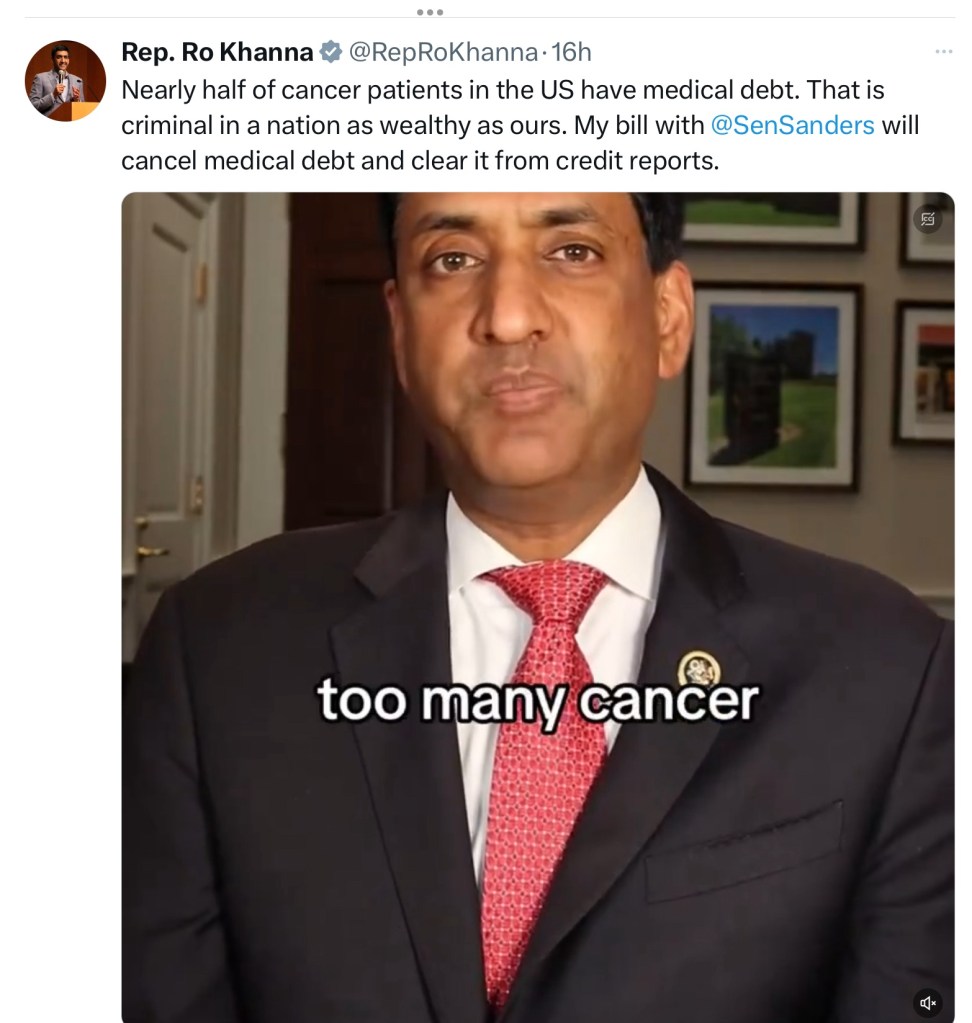
Canceling any debt does not solve the problem and is political gibberish.
However, it does raise the question of how much of the cost of health care individuals can reasonably pay.
The cost of the care is driven by the price of the care, the type of care, and the frequency of care.
Who pays the bills?
Medicare – taxpayers, beneficiaries in the form of premiums, deductibles and coinsurance
Employer-based coverage – the employer, workers in the form of premiums, deductibles, coinsurance, taxpayers in the form of tax subsidies – perhaps lower pay
Medicaid– taxpayers and beneficiaries to a limited extent
Private insurance – the insured in the form of premiums, deductibles and coinsurance, all taxpayers to the extent there are premium subsidies
Veteran’s coverage – taxpayers
If you lower out of pocket costs, premiums must go up.
If you eliminate all cost sharing, demand for services and prices and premiums go up.
If you lower insurance premiums, coverage must decline or costs shifted elsewhere (employers, taxpayer). Yes, insurance profits woukd decline, but keep in mind between self-insured plans, Medicare, Medicaid, veterans and the Military less than half of Americans actually have health insurance.
Costs could be lowered if the prices for goods and services is lowered, but that is not without consequences – access to care, shortages, wait times, slower growth in medical advancements are all possible.
Bottom line is we all pay for health care even if we never use a health care service.
To make it more complicated, Americans, in varying degrees, don’t want government involved, don’t like health insurers managing care, want complete freedom of choice and above all don’t want to spend their hard earned dollars on health care. They are also misinformed about insurance company profits and generally equate the quality of care with its cost.
So, do we face a unsolvable problem? Can we continue as we are and meet all the competing demands, including affordability?


 QUINNSCOMMENTARY
Insurance is paying a premium to a Third Party to be responsible for a risk which you don’t want to be (responsible.) As a country we Americans pay far more for health care but, overall, are less healthy than other developed countries. We demand the finest medical care, with personal choice of providers, but we want the other guy to pay for it.
LikeLike
Don’t simply equate the cost of health care with outcomes. Our health status has more to do with lifestyles than health care.
LikeLike
I disagree. I have travelled to six continents and observed other nationalities that also have unhealthy lifestyles. However those countries achieve better healthcare results, at a lower cost.
LikeLike
If cost was not an issue, what other country would you prefer to receive health care for something serious?
LikeLike
The USA is my first choice for serious health issues. In Asia, I would first opt for Singapore, Health care is excellent in the USA; however, the premium we spend does not result in superior out comes. My point is that other advanced economies also achieve good results; can we learn from them? Or should we spend increasingly more as a percent of GDP? Can our society afford that? American companies offering health as an employee benefit places them at a disadvantage, which makes them less competitive internationally. We usually agree and perhaps we are parsing semantics. My contention is that if I pay the highest price, I want to highest out come. So convince me that the USA has it right, spending more and achieving less is the best health care system. We can disagree and still be friends. Time to enjoy a burger on Memorial Day 🙂
LikeLike
The fundamental problem is the uncoordinated system, two many different delivery approaches. The prices in terms of premiums includes many factors not directly related to the care provided. American demands for the most, quickest and latest technology and convenience also add to cost. If I invest in the latest equipment, there is only one way to pay for it, use it. Plus private sector fees and volume are driven by the need to make up what Medicare and Medicaid don’t pay.
LikeLike
The MMT mindset has taken hold of a lot of the Biden Administration and Dem Congress members. They don’t understand why debt matters if the government can print more money.
Medical care cost is a problem I can’t see a way out of. If you take all the profit earned and plow it back in to the system, would it affect the cost to the consumer greatly or marginally? I don’t know. If we put everybody on equal footing to access medical care on demand, would that break the country and could the current number of providers handle it? I don’t know.
Summing up, it’s beyond my pay grade.
LikeLike
“cancel the debt”–so nobody pays for the debt–like student loan debt–it’s free just wave the pen and its done–how much credibility do you give someone who says; cancel medical debt is “often justified.”
this is one reason we have this debt issue –the misinformation, or is a lie, that we just cancel debt–the bond holders, as an example, will suck it up and not be paid.
There really is a free lunch!!
LikeLike
Just another Bernie convert that thinks everything should be free !
LikeLike
Who said anything about free?
LikeLike
Just look at the recent public announcement of a dozen HCA executives routinely cashing in their stock options: half a million here, three million there, or Ralph de la Torre at Steward pulling down $16 million a year while leading this health system straight into bankruptcy. The profit motive is the cancer of American healthcare, and not even Amazon is making it work. Single payer is the only solution, but it won’t happen in America. Far, far too many individuals singing the song of quality patient care out of one side of their mouths and buying $40 million yachts (as de la Torre did) out of their bloated earnings packages on the other.
LikeLike