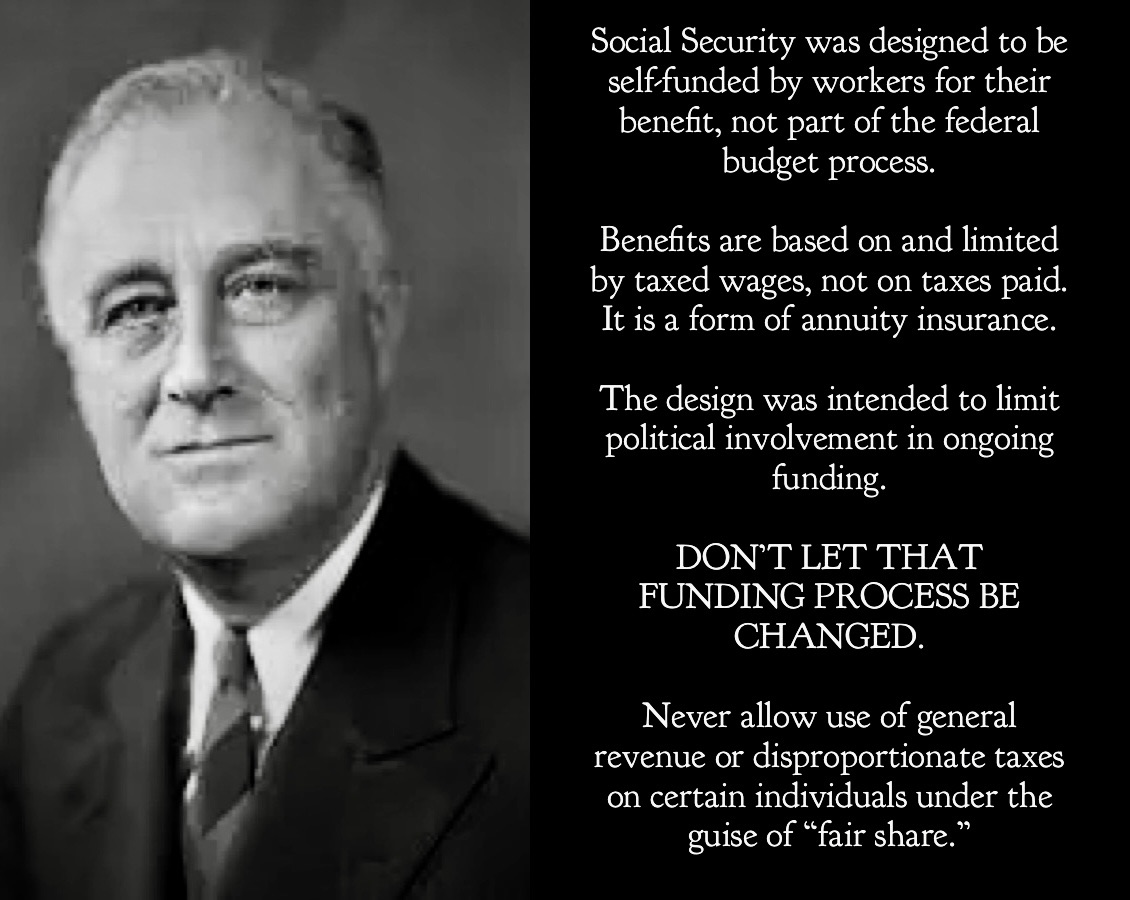
Let’s not lose our way in the turmoil of politics

We can’t control what others do and we can’t stop misfortune from striking. But we can control our own actions. Those who are financially prudent will most likely enjoy success, even if events don’t always go their way.

 QUINNSCOMMENTARY
The benefit provided by Social Security is highly progressive. So, those at the “lower end” who survive to collect old age benefits typically receive a substantial, favorable return on the taxes they and their employers’ paid. The bend points in the formula for someone reaching age 62 in 2024 are:
PIA formula
For an individual who first becomes eligible for old-age insurance benefits or disability insurance benefits in 2024, or who dies in 2024 before becoming eligible for benefits, his/her PIA will be the sum of:
(a) 90 percent of the first $1,174 of his/her average indexed monthly earnings, plus
(b) 32 percent of his/her average indexed monthly earnings over $1,174 and through $7,078, plus
(c) 15 percent of his/her average indexed monthly earnings over $7,078.
https://www.ssa.gov/OACT/ProgData/retirebenefit2.html
Average Index Monthly Earnings (AIME) is the 35 years with the highest income subject to FICA taxes.
So, an individual with AIME of $1,174 ($14,088, $15,060.00 if federal poverty in 2024), receives an inflation indexed monthly benefit at Full Retirement Age of $1,056 (plus a spouse’s benefit of up to 50% of that amount), or 84% of the federal poverty level. Assuming the spouse’s benefit is 50% of the worker’s benefit, that would be $1,584 per month or 93% of the federal poverty level – and 135% of the Average Indexed Monthly Earnings!
The only benefit that is more progressive compared to Social Security is Medicare – where an individual reaching age 65 in 2024 could have paid in less than $1,000 and would still receive non-contributory Part A Hospital Insurance coverage free for life, and non-contributory free for life coverage for a spouse who paid in nothing. That same individual, assuming meager wages, would also qualify as dual eligible for Medicare Part B and Part D and Medicaid – where there would be little or not premium nor cost sharing.
The benefits were always intended to form a base of income and health coverage. They certainly accomplish that for individuals who paid in for 35+ years – heavily weighted to those with lower incomes throughout their working careers (and those who have gaps in their employment history).
LikeLike
Congressional Legislation written and approved many decades ago is not sacrosanct.
Circumstances do change. Unfortunately, there are millions of seniors who have inadequate savings and the social consequences without additional support will be devastating. That is not an understatement. The most expedient measure is to increase S.S payments to the more needy seniors. It’s a hard reality but I think it’s necessary.
LikeLike
maybe what we need is something like the base closing commission that agreed on beforehand its findings would be binding–maybe that is what happened back when Greenspan/Reagan made some fundamental changes in the system.
LikeLike
There won’t be any change in the funding process, there is a huge amount rolling in. That will never be stopped and only increased. Even the dumbest pol can see that. The problem a lot of people have with the program is that it provides chump change at the lower end even after a worker paid in a working lifetime. Asking them to kick in more and still get a meager payout is bad optics at election time.
LikeLike