
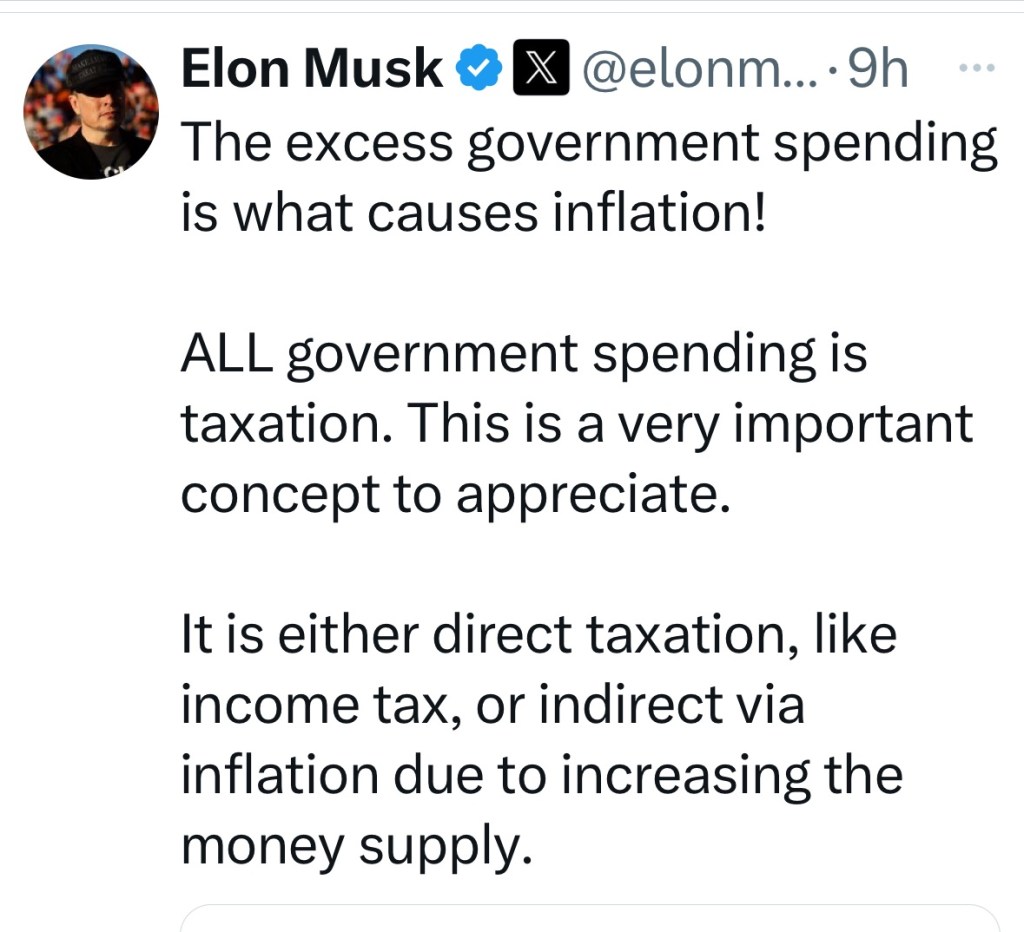
Define excess Mr Musk. If he is referring to stimulus payments, he has a point. But there is more to it.
However, beware. No reduction in government inefficiency as his quest implies will matter to any significant degree.

Soo … what government spending does he propose reducing that will not negatively impact millions of Americans?
The Cato Institute has some suggestions including Medicaid, school subsidies, transit subsidies and more.
In other words, the net result will be elimination of services people want or shifting costs from the federal budget to yours via the states.

 QUINNSCOMMENTARY
Not sure, because it’s complicated, and I didn’t follow it closely, but how did Musk’s cutting of waste, fraud, and abuse work out for Twitter/X?
LikeLike
“…I know from experience at the state level that performance evaluation of employees is lacking.”
Not sure what you mean by that, but…
“According to Gallup, only a shocking 29% of government employees are engaged at work. Engaged employees provide high quality service to their communities. Disengaged one’s at times do more damage than good. Unfortunately, 71% of state and local employees are not engaged.”
—-Costing the U.S. Billions—-
According to Gallup, the same is true, if not more so, in the private sector.
I’ve said it before, most public employees are not, per se, public employees. They are private sector employees on but one of a series of jobs in their career. Logically, a lot of the waste, inefficiency, etc.(fraud and theft?) are similar in the private sector also. Who do you think pays for that? Rhetorical question, it’s the taxpayer, out of his other pocket. Inefficiency, and dishonesty in the private sector are a greater cost, just due to relative volume, than “excess” government spending.
Who’s going to control that?
LikeLike
Where exactly do you think the money comes from to pay for these programs? Otherwise, I prefer the spending and taxation take place at the lowest level of government possible.
LikeLike
Right now it comes from the future via debt plus taxes. Many/most people say that until their Ox is the one gored.
No doubt there is room for much efficiency and I know from experience at the state level that performance evaluation of employees is lacking.
The people now in charge of government have a narrow view of government and I suspect little understanding human nature.
Will cutting the ACA subsidies save money? Sure, at what cost to millions of Americans?
The key to lowering the debt is gradual. Stop new spending not fully and permanently funded, gradually increase revenue via taxes or to some extent growth, trim spending where practical without harmful consequences. I have no doubt each department could easily cut their admin costs by 5 to 10%, but I recall the reaction years ago when someone tried that at 5%
LikeLike
I won’t hold my breath waiting for much of what you propose to happen.
LikeLike
Those ACA subsidies are paid by other taxpayers, today (or if add to deficits) tomorrow.
where a program create economic efficiencies, and erroneously removes a burden from one taxpayer who could afford to pay for their coverage to foist it on another, that is something to crush.
we erroneously created that dependency as 75+% of those without coverage in 2008-2009, could afford to pay the cost of health coverage ( at least in states that didn’t screw up coverage like NY, NJ, WA, etc.)
now they are sucking on the taxpayer teet.
LikeLike
75%?
LikeLike
Yeah and 75% of retirees can pay more than the standard Part B premium too, yet many go through all kinds of gyrations to avoid IRMAA $1,000,000 in a Roth gets you off the hook
LikeLike
typo, inefficiencies, not efficiencies in my most recent post.
LikeLike
“In 2021, taxes at all levels of US government represented 27 percent of gross domestic product (GDP), compared with a weighted average of 34 percent for the other 37 member countries of the Organisation for Economic Co-operation and Development (OECD).”
https://taxpolicycenter.org/briefing-book
LikeLike
There are cycles to political movements; but excess in one cycle usually leads to an opposite cycle in the other cycle. The 2024 election illustrates this cyclical nature. If the Trump and Republican agenda leads to an excess, the voters sooner or later will shift towards the democrats. I guess it is inevitable these cycles as history has repeated.
So Mr. Quinn , don’t fret. The republicans have their turn at the bat and later they will strike out. When is anyone’s guess.
LikeLike
You need an initial target for Elon/Vivek – read today’s WSJ:
What Does HUD Have to Show for the Trillions It’s Spent? The U.S. homeownership rate was 64% in 1967, two years after the department opened. Now it’s . . . 64%.
“… One of the biggest issues confronting young Americans is the decline in homeownership due to escalating mortgage costs. Lyndon Johnson’s Great Society program created the Department of Housing and Urban Development to reduce housing costs and increase homeownership. In the signing ceremony for the HUD Act of 1965, Johnson promised that it would “become known as the single most valuable housing legislation in our history.” What are the results? In 1967 the U.S. homeownership rate was 64%. Nearly six decades and $3 trillion of spending (in 2024 dollars) later, according to the U.S. Census Bureau, the home ownership rate is nearly . . . 64%. …”
“… It would be easy to say that American taxpayers have gotten nothing in return for our $3 trillion, but it’s worse than that. U.S. rental and home prices have increased faster than inflation. In 1967 the average home cost about three times an average family’s income; today, it’s seven times. …”
“… The $3 trillion in HUD spending is only part of the price tag for taxpayers. A 2019 MIT/Sloan study puts the cost of bailing out government-backed mortgage companies such as Ginnie Mae, Fannie Mae and Freddie Mac after the 2008 financial crisis at $500 billion. The housing crisis of 1989 cost about $300 billion in 2007 dollars. The FHFA writes off about $25 billion a year in bad mortgages, according to its May report. Add it all up, and the U.S. has spent about $4 trillion since 1965 without increasing homeownership, making homes more affordable or reducing rents. And we’re at risk of another financial crisis brought on by overly levered personal balance sheets. …”
LikeLike
So, that’s your assessment of all that HUD does for Americans? Growing home ownership?
LikeLike
Can you identify any specific success achieved by HUD?
Here is their portfolio. https://www.hud.gov/topics
Identify anything that you think is worth $4 Trillion.
Give it your best shot.
LikeLike
I guess you never saw a govt program that could be eliminated.
LikeLike
There are many that should never have existed, but once implemented very hard to eliminate. Right or wrong people become dependent.
LikeLike
So, if people become dependent we just continue on? That’s why the debt is where it’s at.
LikeLike
People love to hate the government until some service they want is not available. There is plenty of waste and certainly it makes sense to scrutinize costs and reduce it where possible, but unfortunately the politicians are more interested in making political points than addressing the real problems. The majority of people have no idea where most of the money is spent and what it will mean to them if that spending is cut. And thinking that volunteers who know nothing of the inner workings of the government will ferret out all of the waste without the assistance of the employees who really know what happens within agencies is lunacy in my opinion. There is also a huge conflict of interest given that Musk has interests in so many areas that the government regulates.
LikeLike
You seem to think that all federal spending is sacrosanct and that it is all based on the needs and wants of the people. Did we choose all spending by referendum or did it get foisted on us by a slim majority of representatives who may or may not know what they were getting into at the time. Once started, every program grows a constituency and happily spends as much as it can get its hands on.
What tax rates are necessary to cover the current deficit and what tax rates will be necessary to cover future increases in spending. Are you willing to support that spending?
LikeLike