
This should be a joyous celebration of Americas achievements, of our unique system of government, our leadership among nations, our embracing the values in our founding documents applied to all people that we have fought for over two and a half centuries.

Instead, we have allowed one man to tear us apart with words and deeds, to undermine our trust in our government, to pit citizen against citizen, to lower our standing in the world, to exercise undue power and control and to express disdain for Americans.
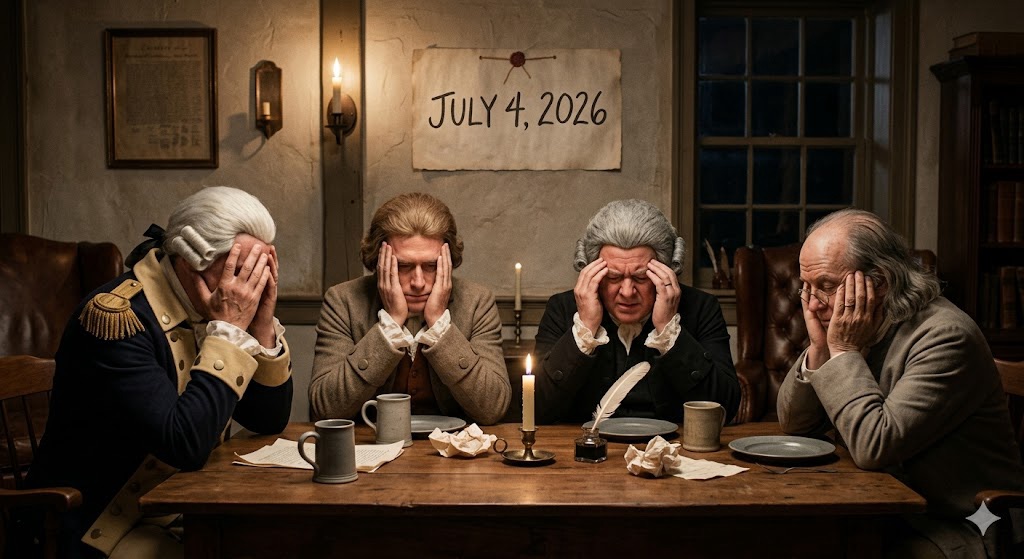


How did this happen? How did we allow a man to lead us who is blatantly corrupt, a compulsive liar, power hungry and who promotes racism, bigotry, xenophobia and Islamophobia while hiding behind a religious Christian facade?
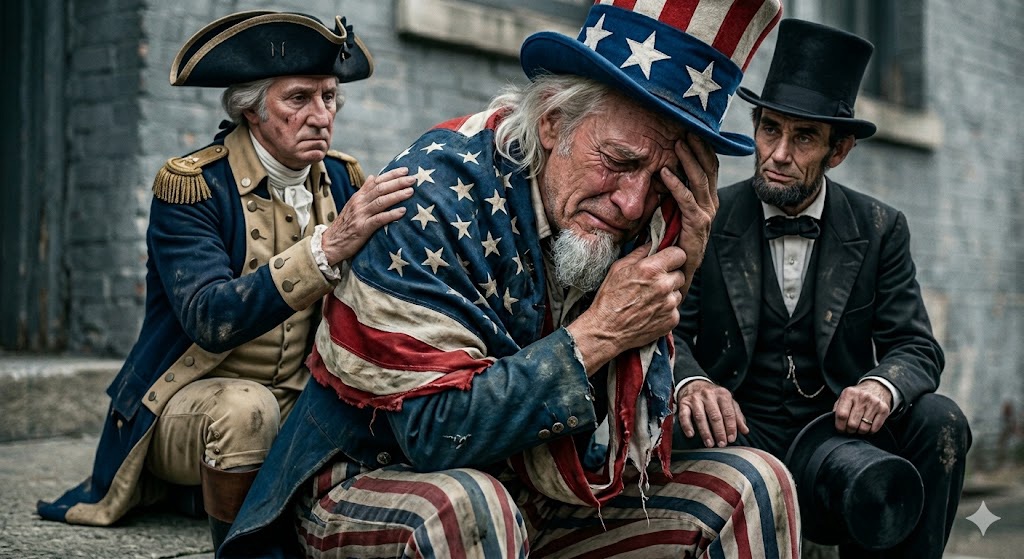
We can only hope that a truly United States of America for all the people is possible once this nightmare is over.


Or, from TV/POTUS commentator Michael Smerconish of Philadelphia this morning – separating media reporting from personal interaction with people in America:
Happy Fourth of July. And not just any Fourth – today America turns 250.
A birthday is when you take stock.
So here’s the uncomfortable question on the way to the fireworks: at 250, how does the rest of the world actually see us? The answer, lately, isn’t pretty. A new Pew Research Center survey of more than 42,000 people across 36 countries finds a 57 percent majority now view the United States unfavorably.
Eighty percent in Sweden.
Seventy percent in France.
Sixty-six percent of Canadians.
And it’s our oldest friends pulling back the hardest. In Canada, 83 percent called us a reliable partner in 2022. Today, just 35. Across all 36 countries, only about a third still believe the U.S. contributes to peace and stability in the world – down sharply since 2023. That’s the birthday card from abroad. Not exactly warm.
But something else is happening at the exact same time. America is co-hosting the World Cup.
Oxford Economics estimates more than a million international visitors are here – and they’re sending word home about what they’re actually finding. The word is good. And it’s not the postcard stuff. It’s the ordinary stuff. Free ice. Free refills. The sheer scale of a Walmart. Buc-ee’s toured like a theme park. Ranch dressing so beloved the TSA reminded fans to pack it in checked bags. Scottish fans adopted Boston so thoroughly that locals are calling it “New Scotland.”
But the part that stops you cold isn’t the food.
One British fan put it bluntly: “We owe America a huge apology.”
A Scottish woman, near tears, said they’d braced for the angry country they see on the news.
Instead, they found “the America we were promised growing up.”
The polls measure perception. The visitors are measuring us. And the gap between those two things might be the most American story there is.
Happy birthday, America.
LikeLike
From a blog I read.
On this 250th Anniversary of American Independence, Try Gratitude Instead of Grievance.
As America marks 250 years of independence, a global perspective reminds us why gratitude—not cynicism—may be the most authentic form of patriotism.
Jul 4
∙
This morning, I did not need to boil my water to drink it. My power has been on uninterrupted for many months. When I go out later, the vast majority of other drivers will be predictable and follow traffic laws. I will inevitably, at some point, criticize people in power in a very direct and public way, and I will not fear retribution from the government or other powerful people for doing so. When I go to the store, prices will be higher than I like, but they will probably be exactly what’s listed on the shelf, and the products I buy I can almost certainly expect to work properly. If I go for a walk in the park, strangers will greet me with a smile and a “hello.” I will drive past a farmstand that consists only of a shelter, products, and a box to put money in, unmonitored, and there will be both cash and products there. I recognize this isn’t universally true. Prices are unaffordable for some families and a walk in some neighborhoods carries real risk. These are real exceptions, and they matter. But my point is that these are exceptions, not the rule.
I type this from a nation about to turn 250 years old, having spent a great deal of my life in places where all of the above have not been true.
No, I have not described a utopia, but I have described a place we have all taken for granted — or even worse, needlessly denigrated, at one point or another.
Although I do not use social media, I know well that if I took a look at any social media platform I would be bombarded by nonstop cynical rhetoric about how America is a great evil in the world, a failed state, a terrible place to live, a place some long to escape from — a pox on the earth that would be best undone and abandoned.
I think we can reasonably expect that rhetoric to escalate quite a bit at the least appropriate time, as we celebrate 250 years of independence. But I believe a bit of thanks for that independence feels more in order.
Gratitude work has become widely regarded as a huge boost to mental health. The concept is simple: spending time intentionally focusing on what we are happy about in our lives can give us (according to an article from Harvard Women’s Health Watch) “… greater emotional and social well-being, better sleep quality, lower depression risks, and favorable markers of cardiovascular health.”
So, gratitude is good for us. Knowing this makes many anti-America remarks and the deep and unrelenting cynicism on social media look as bad as a pack-a-day cigarette habit.
Some will criticize the US as being “no better than a third-world country”, losing sight of the incredible comfort that we (yes, even many poor people) experience here compared to the vast majority of other countries. Others will talk about how the founders guaranteed only the rights of “rich white men”, willfully disregarding the slow but undeniable progression to guaranteeing those rights for everyone and how absolutely novel that is in history. Others will claim that America “has no culture,” an odd statement to make about the greatest cultural exporter in modern history — a culture that would not be nearly as rich without the contributions of those people they see as “systemically oppressed”.
They’ll make these criticisms from their safe, comfortable, air-conditioned homes. They’ll make them with zero fear of retribution or consequence. They’ll make these criticisms to an audience of similarly cynical, resentful, and ungrateful people who will reinforce their vitriol.
To me, this is like the teenager in the McMansion who screams at his parents, storms out, and speeds off in the BMW they bought him. Where are you going, kid? You’ll be back in your nice bedroom with your childhood toys tonight, and your parents probably won’t even ask you to apologize for your behavior.
That said, there is absolutely plenty to be unhappy about. I believe that on almost all fronts, American society is declining and losing much of what makes us special. I fear that my ability to live on my own terms here is under threat more and more as time progresses. But I also believe that a big part of the reason these problems exist is because so many in our “intellectual” classes are demoralized by this relentless strain of perspective-free self-hate.
A part of how we got here is social media: cynicism, self-righteousness, and snarky jabs at those who are perceived as “powerful.” Hot takes generally play better there, as they drive engagement. That seems to reinforce the shibboleth-like nature of American self-hate as a means of accessing the purported “intelligentsia”. As Benedict Beckeld, author of Oikophobia: Why Successful Societies Turn Against Themselves, says:
“Like Diogenes’ sneers and sarcasms about his fellow Greeks, or Voltaire’s snarkiness about French tradition and religion, little virtue-signaling asides about American faults are de rigeur for those Americans wishing to communicate how cosmopolitan and superior they are.”
It should not be news to anyone that spending all of one’s time incessantly criticizing others is not a strong indicator of moral superiority, but rather a substitute for it. Confidence and competence are quiet because security does not require belittlement.
Having spent half my adult life living in the People’s Republic of China and a great deal of time traveling the rest of the world, I can tell you this: having a global perspective puts the contrast between American society and most others in the world in stark light.
My anecdotal experience aside, simply looking at net migration numbers tells you an undeniable story: In 2025, enough people chose the United States over their home country that, standing in a line holding hands, they would stretch from New York City to Miami.
Being grateful does not mean willfully ignoring real problems or being revisionist about history. But willful ignorance and revisionism cut both ways: as much as they can be used to “whitewash” true evils, they can also be used to reinforce needless negativity. You know what’s wrong with America today. You’re probably bombarded with these problems in your social media feeds, so I’m not going to spend time discussing them here. I, too, am feeling the embarrassment of our broken political system and the existential dread brought about by the state of our economy.
Yet despite the challenges we face today and the many ghastly moments of our history, what we choose to focus on is key to the solution. Allow me to anthropomorphize our nation for a moment. Have you ever loved someone whose bad choices brought them to a bad place? If you truly wanted them to get better, would you spend your time constantly berating them for their flaws and proclaiming how bad they are to everyone you both know? Once you’ve acknowledged their reality, what is the purpose of staying critical? To feel better about yourself? Because some part of you fears you’re just like them? Be honest.
So on this anniversary of independence, if you feel compelled to say that we are inappropriately celebrating 250 years of oppression, imperialism, exploitation, racism, slavery, brutality, and warmongering, spare us the complaints. Take that energy and go make something better instead.
We here in the USA are so damn lucky. Yes, even you. And while things may feel dystopian at this particular juncture in our history, only by choosing to be grateful for what we have can we stave off those threatening to take it away from us.
As we celebrate America’s 250th birthday, join in cultivating a common culture of gratitude. The more of us who do, the less we’ll have to criticize.
LikeLike
First, Happy Fourth of July. May we celebrate many more for the lifetimes of my children and grandchildren. And more.
Second, according to some, Trump is the third worst president ever. Surely James Buchanan and Andrew Johnson can rest easier now.
Comparison to Carter, Clinton, Biden, and even Nixon are asinine. Trumps damage isn’t limited to the U.S. He is the most powerful, and most destructive man in the world.
“There are no limits to my power.” Trump said,* (and I weigh 224 pounds.)
Yes, the country, and the world, can recover from Trump’s damage, but it will take years. I doubt Trump will complete this four year term. I only hope I live long enough to see him in prison.
*“Yeah, there is one thing,” Trump replied. “My own morality. My own mind. It’s the only thing that can stop me.”
LikeLike
Whether Trump ir removed from office prior to 1/20/29 or not (assasination, impeachment/conviction, or tail between his legs departure), America and all the world will move on no later than that date.
There is nothing permanent about his presidency, hell, nothing even indefinite about his presidency, neither the legislation, nor the executive orders.
Name one thing (a piece of legislation, some addition of a positive or deletion of a negative) that we can attribute to his presidency that isn’t personal to Trump so that it will remain once he moves on.
I suppose you could attribute the nomination of justices followed by reversal of Roe v. Wade. However, all that decision did is return it to the states where most states have embraced reasonable limits on abortion.
Perhaps the barriers to illegal immigration? Remember that the wall PRECEDES the idiot ass Trump. Congress first explicitly agreed to build a physical wall and extensive barrier network along the southern border on September 29, 2006, when both chambers passed the Secure Fence Act of 2006. Signed into law by President George W. Bush on October 26, 2006, the legislation mandated the construction of roughly 700 miles of multi-layered fencing and vehicle barriers.
I doubt the wall will be completed before he has left the scene. However, even if it is completed, his rants and crap about immigrants have come with a significant cost in terms of the impact on legal immigration.
LikeLike
“Instead, we have allowed one man to tear us apart with words and deeds, to undermine our trust in our government, to pit citizen against citizen, to lower our standing in the world, to exercise undue power and control and to express disdain for Americans.”
Only if you let him. We survived those Americans who voted for Trump in 2016, all four years ending in 2021.
We will survive Trump through a second four year period, ending in early 2029.
Have some confidence in yourself, and America. Just because you hate the guy shouldn’t inhibit your celebration of America on its 250th Birthday.
“How did this happen? How did we allow a man to lead us who is blatantly corrupt, a compulsive liar, power hungry and who promotes racism, bigotry, xenophobia and Islamophobia while hiding behind a religious Christian facade?”
A majority of Americans voted for him in enough states such that he won 270+ votes in the Electoral College. Same reason how we ended up with a guy having sex in the oval office, a President who couldn’t find his ass with both hands, and one who we rid ourselves of way, way back in 1974. We’ve had inept individuals (Carter, etc.) and corrept ones (Andrew Johnson).
“… We can only hope that a truly United States of America for all the people is possible once this nightmare is over.”
Again, we already have that, and we have had that for 250+ years. You forget that half of Americans didn’t want to leave the British Empire, and that half of Americans wanted to secede from the Union.
You overstate the concern, badly. Even today, Americans (not the legal and illegal aliens present in America but who don’t see themselves as becoming/graduating to American citizenship) agree on much more than we disagree on.
LikeLike
As far as overstating the concern, I hope you are right. But I think other countries thought that as well.
The difference with Trump is it’s all out in the open. He doesn’t attempt to hide his behavior and certainly not his rhetoric. And still people support him. That is most disturbing.
LikeLike
People support Trump in part because he is President. People supported Biden, and Obama, and Clinton even though they did not vote for them. I support all three as President, and never voted for any of them, nor Harris, nor Clinton (Bill or Hillary).
What’s the problem?
A new national survey from the Cato Institute, conducted in collaboration with Morning Consult of 2,253 Americans ahead of July 4th and America’s 250th anniversary, finds nearly half (46%) of Americans don’t know what America’s 250th anniversary commemorates.
As the nation celebrates its birth, most Americans feel positive (76%) about the nation’s founding, and 70% believe its founding principles remain relevant today. In particular, overwhelming majorities believe the US Constitution is important for protecting our rights and freedoms (86%) and for enabling America’s prosperity (82%). However, nearly 6 in 10 believe the country has moved away from the founding principles, and 56% worry the US could stop being a free country within the next 50 years.
Americans support constitutional limits, dividing power, and checking the power of the president to maintain their freedoms.
And, at least from my pespective, that applies equally to Republicans, Democrats, Independents and Democratic Socialists. Whether it’s the guy who believes he has “a phone and a pen”, or the current idiot ass with all of his executive orders. Too much power, way beyond the enumerated powers, is already concentrated in our Federal Government.
Another risk to the country is low substantive civic knowledge on basic governance questions. For instance, 58% don’t know what the main purpose of the US Constitution is, and 57% don’t know the reason we declared independence from Great Britain and created our government with limited powers.
To me, those are shocking numbers. As a Baby Boomer and first generation American, I was taught the purpose of the US Constitution, why we declared independence and why America is different. For me, specific comparisons were drawn in three high school classes – my freshman class on World History (not long after WWII), my junior year class on American History, as well as my senior year class in Government.
LikeLike
Shocking indeed, depressing as well and in our time risky, if not dangerous.
Equally shocking to me is the lack of knowledge and willingness to accept false information about things important to us all like SS, Medicare, social support programs even immigrants.
Back in the Trump first term I argued with relatives and friends that even if the didn’t like Trump they should respect the office. Well, Trump has shown the least respect for the office in history. I don’t feel I can even make that argument now.
LikeLike
I went to school in the 1940s and 50s my favorite subject was US history. To this day I can still recite the preamble to the Constitution. I have read dozens of history books and biographies of the founders, each providing more insight often related to events these days.
Did you know two people were drawn and quartered in NJ during the Revolution? That shocked me but indicated how divided it was then.
Over the years I have visited more sites related to the Revolution than I can count. Each time learning more. I live only a few miles from Washington’s headquarters in Morristown and have been there several times, each time learning something new.
LikeLike
There are wonderful documentaries on the History Channel and Netflix on America’s birth – the run up to the Revolutionary War through the Constitution.
One of my favorite shows was a two part PBS series moderated by a British citizen sharing her understanding of the British historical perspective/point of view – Lucy Worsley Investigates the American Revolution. There is also a 6 part PBS series from last year titled The American Revolution. On Netflix, a 5 part series titled The American Experiment.
I’ve spent the last few months relearning much of what I forgot.
Today’s (re)learning: The Dunmore Proclamation, in part:
“… And I do hereby further declare all indentured Servants, Negroes, / or others, (appertaining to Rebels,) free that are able and willing to bear Arms, / they joining His MAJESTY’S Troops as soon as may be … “
https://en.wikipedia.org/wiki/Dunmore%27s_Proclamation
Impotant to remember that while Washington, Jefferson, Madison, Monroe, Benjamin Harrison, Richard Henry Lee (who was the first to make a formal motion for the concept of “colonial independence”), and Patrick Henry were all Virginia representatives to the Continental Congress, Virginia’s vote fpor independence wasn’t secured, independence’s fate wasn’t sealed, the die wasn’t cast, until Dunmore threatened the property (the slaves) of rebels with what may have been history’s first “emancipation proclamation”.
When Jefferson penned “all men are created equal”, he could only say that with a straight face because slaves were property by law in all 13 colonies – not just in the south.
Always interesting to me that Dunmore left slavery in place for the slaves of loyal subjects of the King, and only targeted the slaves of the rebels.
A few thousand slaves got various levels of freedom by responding to Dunmore’s proclamation – some traveled to England, others to Nova Scotia.
LikeLike