
The following is a statement from Maya MacGuineas, president of the Committee for a Responsible Federal Budget:
The gross national debt has doubled in the last ten years; in less than twenty years, it has quadrupled. And today, we have confirmation that the debt has reached a new milestone of $40 trillion. It is staggering how predictable the fiscal decline of a global power can become.
For perspective, it took nearly 200 years for America’s gross debt to reach $1 trillion for the first time in 1981. At that time, President Reagan told the nation in a televised address, “If we as a nation needed a warning, let that be it.” Jumping to America’s 250th year, we are spending more than that just on interest payments on our debt.
And other warnings signs are flashing too, with debt held by the public recently exceeding the size of our economy, the deficit-to-GDP ratio running twice as high as where it should be, and interest costs exceeding our national defense budget.
$40 trillion of debt doesn’t exist solely on the government’s ledgers; it is felt throughout the economy and finds its way to the pocketbooks of people one way or another. The more we borrow, the more we exacerbate inflation, squeeze out other priorities in the budget, and leave ourselves vulnerable to emergencies at home and turmoil abroad.
Correcting our fiscal course cannot be done overnight, but the very first step can be accomplished right now: committing to No New Borrowing. From there, lawmakers should urgently agree on a fiscal goal for the nation – targeting 3% deficits to GDP has bipartisan support already – and finally address our long-imperiled trust funds, both of which can be accomplished through a bipartisan fiscal commission.
Whatever motivation our elected officials need to find to finally take action – whether the worries of their constituents back home, the alarm signaled by financial markets, competition from abroad, or the consequences of failing to act – they ought to find it soon. No one knows how many more of these milestones America can take.
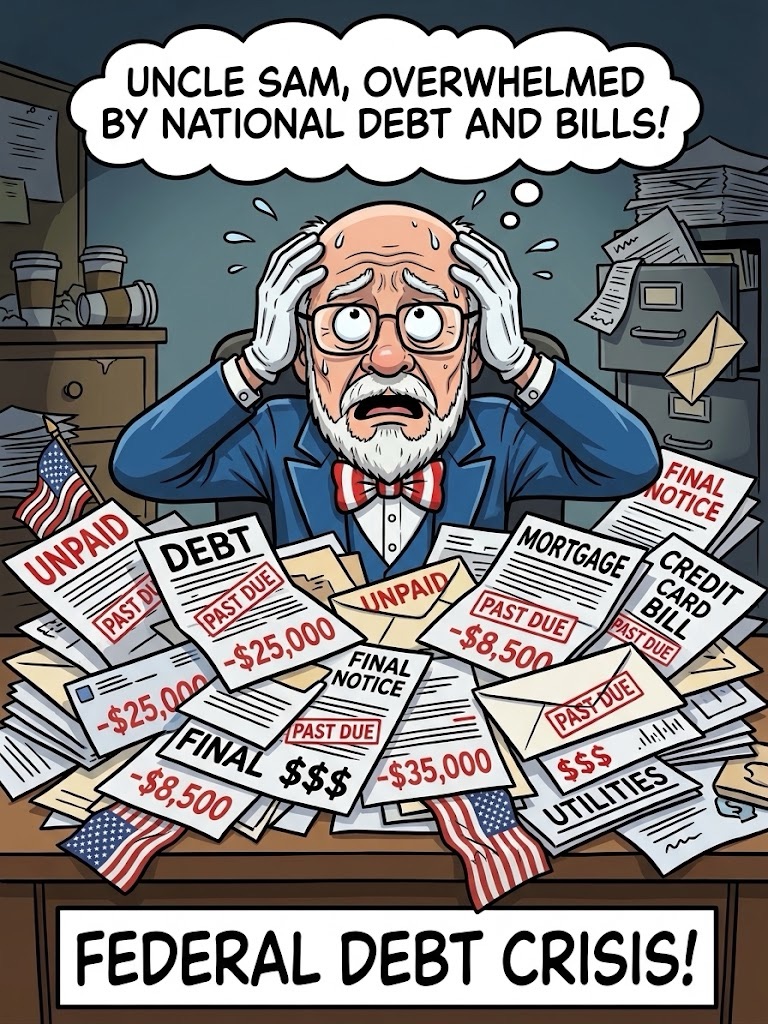


Just as a reminder:
Social Security is a major contributor to our fiscal imbalance. Since 2010, Social Security has run continuous cash-flow deficits, adding more than $1.5 trillion to the national debt, as Treasury debt instruments are redeemed, with projections of $3.4 trillion more by 2032 until the Trust “assets” are exhausted.
LikeLike
I don’t see SS adding to the debt at all. The bonds SS purchased were used to run the country hence the money was needed to cover federal spending so if the bonds were not sold to the SS trust they would have had to be sold elsewhere to cover the deficit spending. If the SS bonds were only sold because of the law requiring that and not federal spending needs other bond sales could and should have been lower. Bottom line, deficit spending adds to the national debt not where bonds are sold.
LikeLike
As you say, if those Treasury instruments weren’t sold to SS Trust fund, Congress would have had the choice of raising taxes or selling bonds to others. The decision not to raise taxes to fund the ever increasing federal spending is the definition of deficit spending.
Other bond sales (or other taxes) were in fact lower because of how FICA taxes were invested in treasury debt securities.
Because FICA taxes were collected ostensibly to pay future benefits, but instead were used to fund other federal spending yesterday, redeeming those bonds increase our national debt, and, simply, they enabled Congress to avoid increasing taxes in the past when deciding to spend more – which increased deficits since 2010 as the bonds are redeemed, and, in turn, our national debt.
LikeLike
And what would be the alternative to the 1939 law? I sure wouldn’t want to see politicians control a few trillion $ in the stock market.
LikeLike
Nothing wrong with index investments to the extent there are assets in excess of amounts needed to pay current benefits.
I also favor acquisition of property, minerals, and back in 1939 and since, new territories, such as Greenland and other plans where we provided defense or sacrifices to retake territory from the Japanese in WWII.
Proposals to acquire Greenland have surfaced periodically in U.S. history, driven primarily by the island’s strategic Arctic location and natural resources:
1867: Following the purchase of Alaska, U.S. Secretary of State William H. Seward investigated the potential acquisition of Greenland and Iceland, though no formal purchase was pursued.
1946: President Harry Truman made a formal, secret offer to buy Greenland from Denmark for $100 million in gold (roughly $1.3 billion today) after World War II – FDR missed his chance to buy it in 1944 when Americans (and only Americans) were defending Greenland against potential Nazi invasion.
2019: During his first term, President Donald Trump expressed renewed interest in purchasing the semi-autonomous Danish territory.
We could have also updated other past attempts to purchase territory, which included:
1854 – tried to acquire Cuba from Spain
1868 – tried to acquire Iceland
1869–1870 – tried to acquire Dominican Republic
1867 – Purchased Alaska from Russia with an eye on other territory north of Canada and west of then-Canada (land routes to Alaska from the lower 48).
1870 – Pissed at Great Britain for supporting the south during the civil war, Seward tried to remove all British owned land from North America. He tried to acquire “Rupert’s Land, owned by the Hudson Bay Company, a British corporation, but they sold to Canada.
1871 – Seward wanted to acquire British Columbia, but it joined Canada instead.
And, we could have retained territory that we relinquished:
1903 – Panama Canal Zone, relinquished in 1979, a treaty granted the US in perpetuity the use, occupation, and control of a zone of land and land underwater for the construction, maintenance, operation, sanitation, and protection of the canal.
1898 – Acquired the Phillipines from Spain, relinquished in 1946.
WWII – Federated States of Micronesia (FSM), relinquished in 1986
WWII – Republic of the Marshall Islands, relinquished in 1986
WWII – Palau, relinquished in 1994
And, it’s not as if we have no experience with sovereign wealth funds.
For example, the Alaska Permanent Fund is a state-owned sovereign wealth fund was established in 1976 to save at least 25% of the state’s mineral lease rentals, royalties and gas revenues to be invested in global markets.
The Alaska Permanent Fund Corporation (APFC) manages and invests the principal across stocks, bonds, real estate, and private equity. A portion of the fund’s earnings is used to pay a yearly cash dividend to qualifying residents, functioning as a real-world universal basic dividend model.
It transforms finite natural resources into a permanent, renewable financial endowment for public services and future generations – having generated over $114 billion in total returns since its inception 50 years ago.
Other sovereign wealth funds include:
Texas Permanent School Fund & Permanent University Fund: Among the oldest state investment vehicles in the country, funding public education and higher education using land and resource revenues.
New Mexico State Investment Council: Manages a massive collection of permanent land and severance tax funds supporting state budgets and education.
North Dakota Legacy Fund: Receives a portion of state oil and gas production taxes to build long-term wealth for the state.
Permanent Wyoming Mineral Trust Fund: Saves mineral extraction and severance tax revenues to support future state government operations.
Alabama Trust Fund: Holds and invests capital derived offshore oil and gas royalties for public benefit.
Keep in mind that the U.S. federal government owns about 28 percent of all land in the United States, totaling roughly 640 million acres. Most federally owned property is concentrated in Alaska and the Western states.
No need to be afraid to invest surplus assets not needed to pay current benefits as if the Social Security trust fund was a pension plan.
LikeLike
I wrote this almost a decade ago. It was an update of what I wrote more than two decades ago.
The trust fund exhaustion for OASI and Medicare HI has been obvious for over four decades, pretty much immediately after the 1983 Social Security Amendments Act. So, failure to act includes the administrations of:
George H. W. Bush,
Bill Clinton (both terms),
George W. Bush (both terms),
Barak Obama (both terms),
Trump (first term),
Biden (only term), and
Trump (second term, so far).
Assuming the House and or the Senate changes leadership after the midterms, and that the idiot ass Trump is not impeached and convicted, let’s see which Democratic leader in Congress introduces bipartisan legislation that will resolve the funding deficit.
Excerpts from a long ago blog post:
The Government Accountability Office recently issued a report … GAO-18-111SP, “The Nation’s Retirement System: A Comprehensive Re-evaluation Is Needed to Better Promote Future Retirement Security” (https://www.gao.gov/assets/690/687797.pdf). The report asserts: “The U.S. retirement system, and the workers and retirees it was designed to help, face major challenges. … Social Security’s retirement program (Old-Age and Survivors Insurance): Beginning in 2035, this program is projected to be unable to pay full benefits.“
They recommend, in part “Congress should consider establishing an independent commission to comprehensively examine the U.S. retirement system and make recommendations to clarify key policy goals for the system and improve how the nation promotes retirement security.”
If there is a “retirement crisis” in America, it isn’t the result of less access to DB plans or the dominance of 401(k) plans. While it would be nice to see Congress create a national retirement policy, that isn’t it either. If we have a “retirement crisis,” it is the result of Americans’ failure to save and a government promise of Social Security benefits that are much greater than projected tax revenues. …
Social Security Funding: … So, in 2035, when the Trust funds are exhausted, without action, benefits will be reduced to match what can be financed by payroll taxes. This is nothing new – it’s been known since 1983, which was the last time Social Security was reformed.
See: https://www.ssa.gov/OACT/TR/2017/tr2017.pdf
Social Security Reform Over the Last 25 Years:
• November 5th, 1993: President Bill Clinton, by Executive Order #12878, created the Bipartisan Commission on Entitlement Reform (the Danforth Commission) to evaluate entitlement programs – specifically Social Security and Medicare. The Commission never reached consensus and couldn’t get all members to agree on even an Interim Report. Subsets of the commission members made their own proposals. None gained any traction, nor action. See: http://www.presidency.ucsb.edu/ws/index.php?pid=61571
• February 5, 2005: President George W. Bush made a reform recommendation to add personal accounts and change the COLA. These proposals triggered great criticism, and no action was taken. See: https://georgewbush-whitehouse.archives.gov/infocus/social-security/ See also: https://georgewbush-whitehouse.archives.gov/news/releases/2005/04/200504…
• April 27, 2010: The bipartisan National Commission on Fiscal Responsibility and Reform (often called Simpson-Bowles) met to recommend fiscal reform, including recommendations to reform Social Security. Despite widespread popular support, the report failed to get enough support to send it to Congress for approval.
• June 1, 2016: President Barack Obama, nearing the end of this second term, reminded us that Social Security’s finances needed strengthening. “We should be strengthening Social Security… it’s time we finally made Social Security more generous and increased its benefits so that today’s retirees and future generations get the dignified retirement that they’ve earned.” No proposal was ever made. See: https://obamawhitehouse.archives.gov/the-press-office/2016/06/01/remarks…
• Today’s GAO report echoes President Obama: “… (we) better ensure a secure and adequate retirement, with dignity, for all.” But, it offers no plan of action other than another committee.
…
Congress should start first with Social Security funding, while allowing plan sponsors more time to consider, adopt, and implement PPA 2006 automatic features.
LikeLike