
Nobody stole or misused the Social Security taxes (trust fund) money, nobody‼️
Here is how it works, and has since 1936.
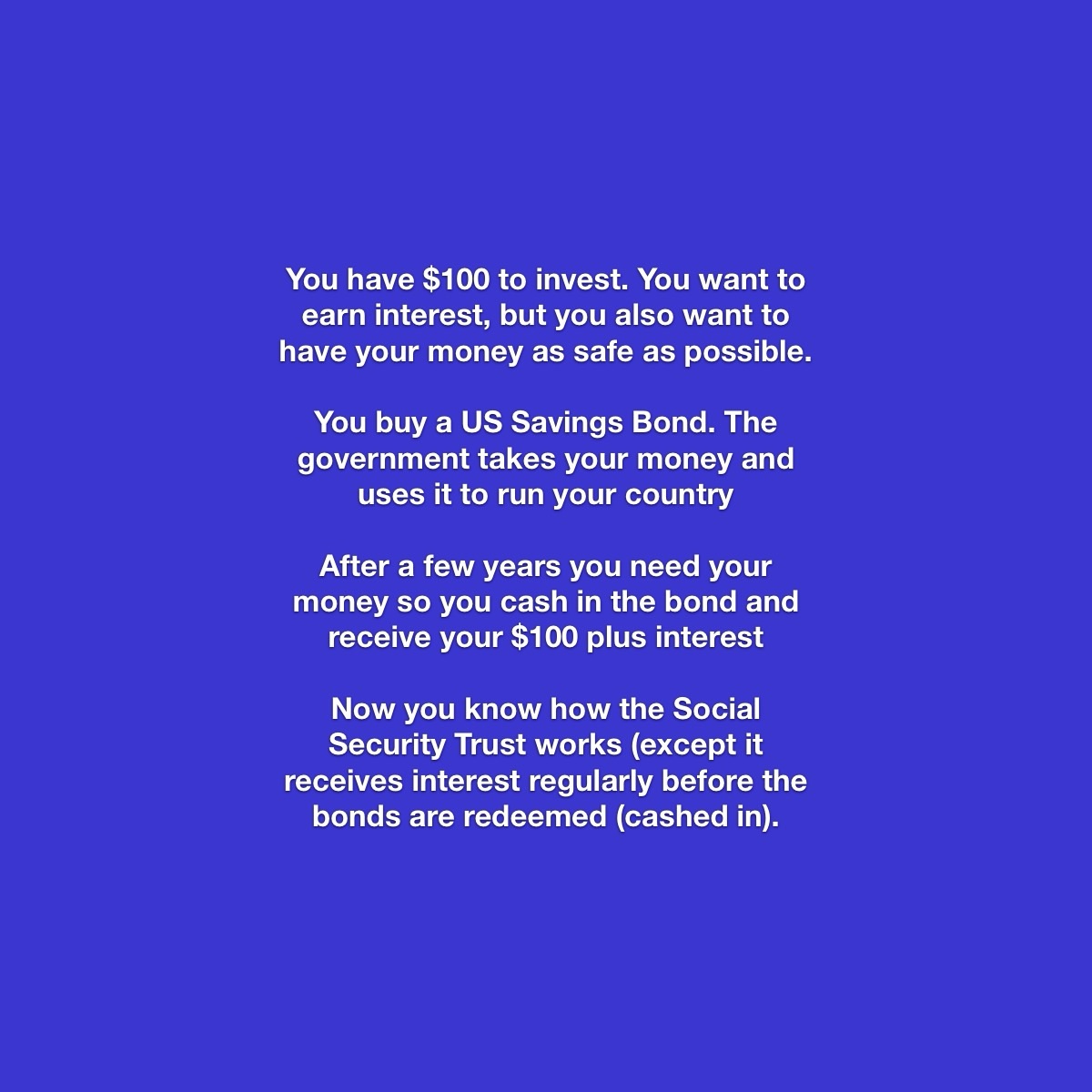
This is essentially how all of our government is financed.
To cover the shortfall and pay its bills, the Treasury Department borrows money by issuing (selling) debt securities, primarily Treasury bills, notes, bonds, and other instruments (like TIPS).
• These securities are sold to investors—including the SS Trust, individuals, banks, funds, businesses, foreign governments, and the Federal Reserve. Buyers essentially lend money to the government in exchange for interest payments and repayment of principal later. The bonds sold to the SS trust are special in that they cannot be sold on the market and do not fluctuate in value.
• The national debt is the accumulation of all past borrowing (mostly from deficits, plus interest). Persistent deficits cause the debt to grow. Interest payments are about $1 trillion a year.
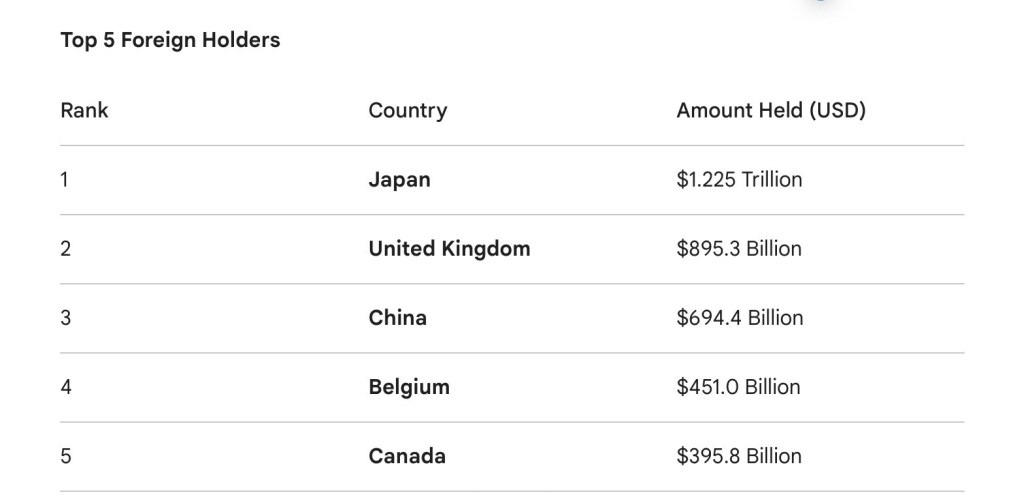
As of the latest reports from the U.S. Department of the Treasury (early 2026), foreign countries hold approximately $9.3 trillion of U.S. debt. While many people assume China is the top creditor, Japan has held the #1 spot for several years.+1
Here are the top foreign government holders of U.S. Treasury securities as of January 2026:
Bonds held by intergovernmental trust fund like Social Security, Medicare and the Highway Trust fund are essentially accounting entries to isolate funds.

These are accounting mechanisms in the federal budget to track earmarked revenues (dedicated taxes, fees, or transfers) and link them to specific expenditures. They do not hold cash separately in a “lockbox”—money flows into the U.S. Treasury’s general account, and the trust fund records credits. Surpluses are invested in special Treasury securities (intragovernmental debt).


No, “vote buying” almost always involves entitlements – some special allocation to some specific group. “Vote buying” can occur without adding to the deficit/debt; but since 1969, it is much more likely they have resulted in deficit spending.
Compounding deficit spending is the vote buying where our federal government creates unfunded mandates for state, local and tribal governments as well as the private sector.
Congress is really good at spending money they don’t have and forcing others to spend money they don’t have either.
There is a reason why we now have multiple executive orders trying to combat regulatory overreach – starting with EO 12866 (and its progeny) https://www.archives.gov/files/federal-register/executive-orders/pdf/12866.pdf Soon thereafter, we got the Unfunded Mandates Reform Act (UMRA) of 1995.
Why do you defend Congressional excessive spending? And, why would you focus on the “lying charlatan” who is simply continuing down the same path of spending abuse long since trod by predecessor administrations?
Remember, whatever you might think of the idiot ass Trump’s tax policy, revenues are expected to increase in every year of his second administration, as they did during the pre-COVID years of his first administration.
LikeLike
So you see all “entitlements” as unnecessary or unwarranted and just buying votes-SNAP, CHIPS, Medicare? Even ACA, just buying votes, no real need or problem to be solved? Congress is not the enemy and neither are billionaires or corporations as many people seem to think.
LikeLike
Clearly, Social Security as originally designed was not vote buying because, as approved, it would have been sustainable, by taxing folks today to build up reserves to fund their benefits in the future. That lasted less than five years before it devolved into vote buying – ever increasing the burden shifted to future taxpayers.
Medicare Part B and D are clearly vote buying excercizes since they were not funded by taxes to be paid into the Medicare Trust Fund – where those who would someday benefit would be assessed taxes today to fund their entitlements – shifting the burden to future taxpayers. Medicare Part A, the HI trust fund, has also devolved into vote buying – when Clinton removed the cap on wages (making it ultra, ultra, ultra progressive) and when Obama added to that by adding the surcharges that were part of Health Reform.
Yes, vote buying.
Health reform, clearly vote buying, extending taxpayer subsidized coverage to individuals, many of whom could afford to pay for coverage, but who decided against that (free riders).
Social security “Fairness” Act… multiemployer pension plan bailout …
Tell me how all of these are not vote buying – awarding monies to individuals while sending the bill to others, most of whom are too young to vote or not yet born?
LikeLike
Well, i for one am glad the Part B and D vote buying happened as my wives treatments are costing $14,000 a week and have since last October. I am also glad the Part D OOP was capped and i am willing to pay IRMAA premiums for it all.
I often think of the people with similar expenses but not with incomes at IRMAA levels.
LikeLike
“Well, i for one am glad the Part B and D vote buying happened”
No, I think you are happy that we added Part B and Part D.
However, I am quite confident you would have been just as happy had those additions been properly funded and not part of the annual deficit, national debt.
Vote buying isn’t necessarily the benefit itself. It is delivering something to oane group and intentionally sending the bill to others – a deliberate, intentional decision to buy votes.
The best trite expression continues to be: “Don’t tax you and don’t tax me, tax that guy behind the tree.” Next: “The best tax is the one I owe and YOU pay!”
The vote buying will go on until it cannot. As Herb Stein once said: “If something cannot go on forever, it will stop.”
LikeLike
I do not see Trump as continuing on any path previously tread by any politician.
LikeLike
Spending and taxation, deficit spending and adding to our national debt, he certainly is on the same path as his predecessors … including Obama, Trump 1 and Biden.
LikeLike
Al Lindquist:
good explanation—Charlie Ellis (Greenwich Advisors) a legend in the investment world, in his most recent book of financial “inventions”, ranks SS # 1–in spite of issues it meet he needs of the recipients, and is vital to the success of this country.
Mr. Ellis was a recent guest of Consuelo Mack on her PBS financial program–when Charlie Ellis speaks it pays to listen.
LikeLike
We can disagree whether investing all of the assets in Treasuries was misuse. I think it was, is, and will continue to be.
“Misused” is the past tense and participle of the verb “misuse,” meaning to use something incorrectly, carelessly, or for an improper purpose.
I have two reasons for my position:
First, most of the liabilities of the Social Security system, in 1936 and today, are decades off into the future – you mention the 75 year period, and I agree. So, since 1983, we were building reserves slowly, in part because of our investment rate of return, investing in short term Treasuries monies to be spent in years after 2010. Anywhere else in America, investing in short term guaranteed securities for a liability that was 25 – 50 years off into the future would have been a violation of fiduciary duties (certainly in ERISA, had this been an insured retirement plan).
Second, investing the money in short term Treasuries allows Congress to spend those monies on every vote buying scheme it wants yesterday and today – most recently, the idiot Biden’s Social Security Fairness Act. We haven’t had a balanced budget in 25 years. Who, how were those deficits and our $39 Trillion in national debt funded? In part, the securities where our FICA taxes were invested.
Yes, that is how it was set up. It was set up, and since 1940, has been misused to buy votes and fund unrelated government spending.
As Mark Twain once said: There is no distinctly native American criminal class—except Congress.
LikeLike
If the SS treasury bonds were not used, then other bonds would be issued, as has been the case since at least 2021 when SS started redeeming. The real stopper, if ever will be when investors don’t want to buy, but of course then interest rates will climb. I think you put too much stake in the vote buying strategy.
LikeLike
I’ve had the role of fiduciary (as an individual and as a member of a committee) for the defined benefit pension and the 401k plan for a Fortune 100 employer (total assets only $10+ Billion).
I believe you had similar responsibilities.
If you were the fiduciary of Social Security, in charge of investing, how would you have invested monies, starting in 1937?
Hindsight is 20/20, however, I doubt you would have allocated all of it to short term Treasuries (8 year maturities). The average annual rate of return from 1940 to 2025 was 5.01%. Not bad for a “risk free” rate of return. $100 invested at 5.01% in 1940 would have grown to $7,200 in 2025.
However, this was belt and suspenders investing, unnecessary conservatism, given the backstop of simply raising taxes (FICA taxes).
I know I would have been much more aggressive.
A $100 investment in 1940 (in predecessors to the S&P 500, the S&P 90 or “Composite Index”) would have grown to over $626,000 today – assuming dividends were reinvested.
Just a little difference, wouldn’t you say, $626,000 vs $7,200?
Myself, I would have likely allocated some of the monies to illiquid investments (land, natural resources, real estate, etc.)
Hell, I might have purchased Greenland and Iceland in 1940 – after Germany had invaded Denmark on 4/9/40 and quickly conquered that country. That gave Germany a claim to both.
The UK occupied Iceland to prevent it from falling to Germany, occupying the island on 5/10/40.
How did America respond? We discharged folks from the Coast Guard, and had them reconstituted as a force of “volunteers” to create a legal fiction that would avoid charges of an American invasion of the country – neither the Germans nor the Danish government agreed to the US “volunteers” invasion. Later, on 4/9/41, the US and the Danish Ambassador to the United States entered into the “Agreement Relating to the Defense of Greenland” – consistent with the Monroe Doctrine and Act of Havana of 1940.
The UK transitioned Iceland to US control on 7/7/41 – before Pearl Harbor and the US entrance into WWII.
In fact, in 1946, U.S. Secretary of State James F. Byrnes offered $100 million to Denmark in exchange for Greenland.
I think we would have gotten an agreement to sell for a much lower price had we made the offer in April 1940 – for both Greenland AND Iceland. Remember, we bought the US Virgin Islands from Denmark years earlier.
LikeLike
I don’t think you made the case the Treasury bonds secure and guaranteed return were not the most prudent choice. What happens to the money after purchase has nothing to do with SS or a Savings Bond someone may buy for that matter.
What major law Americans rely on would you classify as Congress just buying votes? Medicare, SS, SNAP?
Cutting taxes in recent years is all i van think about given current debt and deficits.
LikeLike
What major law Americans rely on would you classify as Congress just buying votes? Medicare, SS, SNAP?
Start with Health Reform. Since 3/23/2010, we have added $29+ Trillion to our national debt, much of it medical spending to reduce the number of uninsured – sending the bill to generations too young to vote and generations yet unborn.
More recent examples, ignoring our almost $2 Trillion annual deficit, how about the Social Security Fairness Act? Or, how about the bailout of multiemployer pension plans? Or, how about the unnecessary super duper dollop of Exchange based COVID subsidies (after COVID vaccines were already widespread) – which extended taxpayer subsidies to many households with incomes far in excess of $100,000?
The list is sooooooo long, and the legislation sooooo complicated, that it is difficult to keep track of all of the vote buying.
Social Security and Medicare also evolved into vote buying. This has been going on since 1940, with the first set of Social Security amendments. Particularly bad vote buying occurred during the Carter Administration and the 1977 Social Security changes. Clinton engaged in vote buying when, instead of significantly increasing Medicare tax rates as needed to properly fund the Medicare HI trust fund, he opted to remove the cap on FICA wages subject to taxation. Bush II engaged in vote buying when he added an unfunded benefit, Medicare Part D. Obama engaged in vote buying with his addition of surcharges for the Medicare Trust fund as part of Health Reform. Every administration since 1983 has been engaged in vote buying by arbitrarily limiting provider charges for services provided to Medicare beneficiaries to levels that today are about 14% below cost (on average, and averages can be deceiving).
I guess it depends on how you define “vote buying”. My definition is an improvement in entitlements or other government spending for existing beneficiaries, especially where the targeted population tends to vote, and especially, where the target population almost always votes for your party candidates (e.g. public employees vote Democrat) where those improvements are not justified based on taxes paid (for Social Security and Medicare, by that generation).
LikeLike
You are more cynical than I care to be. You could say every law ever passed was buying votes in one way or another. Some laws like recent tax cuts are irresponsible for sure and must be buying the next election. I blame the people falling for it all too. Of course the also elected a lying, charlatan.
LikeLike