
Nobody stole or misused the Social Security taxes (trust fund) money, nobody‼️
Here is how it works, and has since 1936.
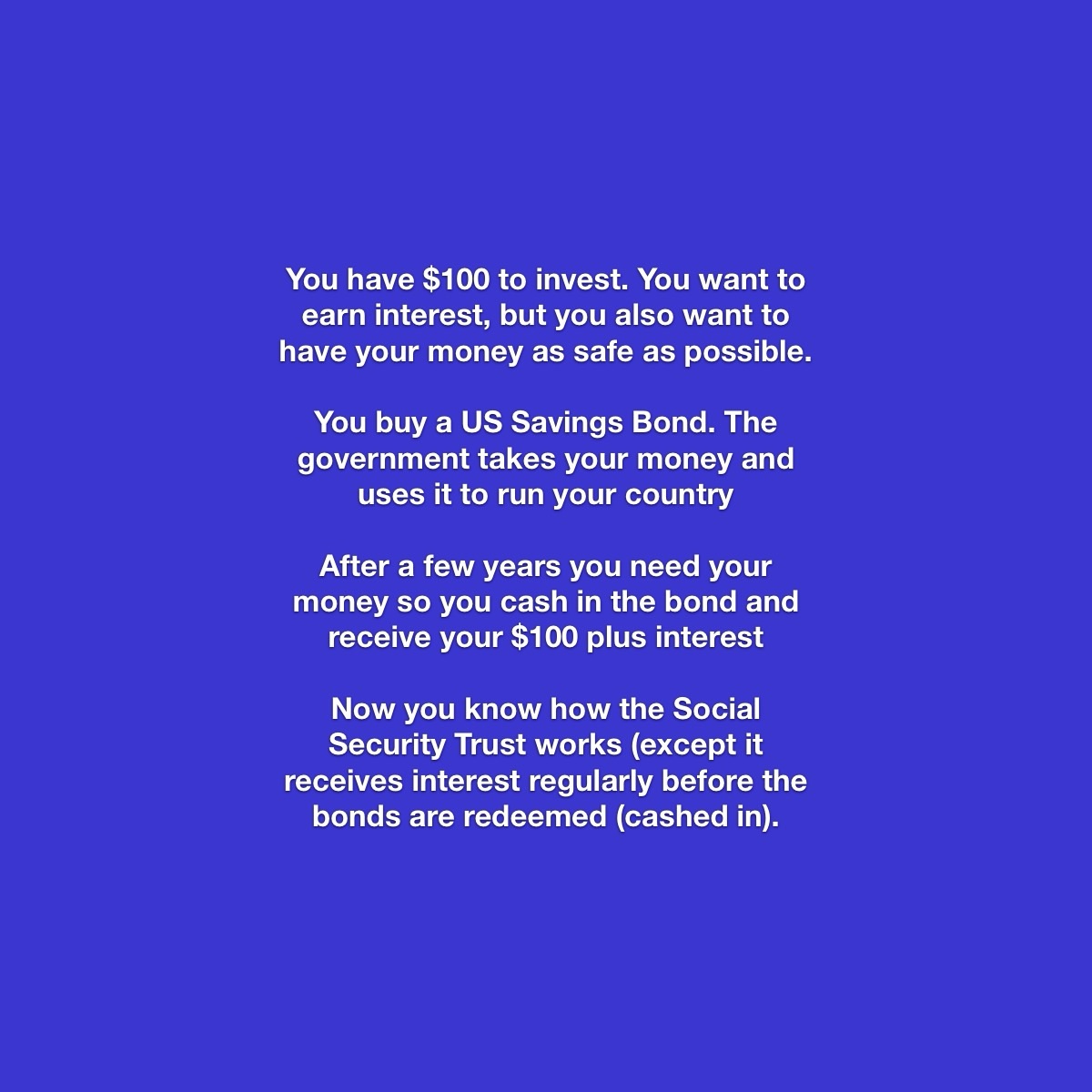
This is essentially how all of our government is financed.
To cover the shortfall and pay its bills, the Treasury Department borrows money by issuing (selling) debt securities, primarily Treasury bills, notes, bonds, and other instruments (like TIPS).
• These securities are sold to investors—including the SS Trust, individuals, banks, funds, businesses, foreign governments, and the Federal Reserve. Buyers essentially lend money to the government in exchange for interest payments and repayment of principal later. The bonds sold to the SS trust are special in that they cannot be sold on the market and do not fluctuate in value.
• The national debt is the accumulation of all past borrowing (mostly from deficits, plus interest). Persistent deficits cause the debt to grow. Interest payments are about $1 trillion a year.
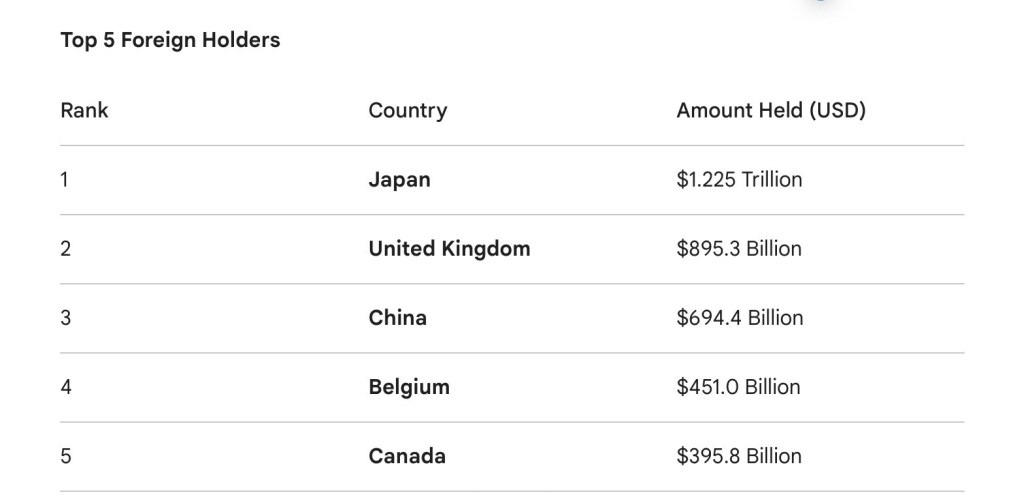
As of the latest reports from the U.S. Department of the Treasury (early 2026), foreign countries hold approximately $9.3 trillion of U.S. debt. While many people assume China is the top creditor, Japan has held the #1 spot for several years.+1
Here are the top foreign government holders of U.S. Treasury securities as of January 2026:
Bonds held by intergovernmental trust fund like Social Security, Medicare and the Highway Trust fund are essentially accounting entries to isolate funds.

These are accounting mechanisms in the federal budget to track earmarked revenues (dedicated taxes, fees, or transfers) and link them to specific expenditures. They do not hold cash separately in a “lockbox”—money flows into the U.S. Treasury’s general account, and the trust fund records credits. Surpluses are invested in special Treasury securities (intragovernmental debt).

 QUINNSCOMMENTARY
Al Lindquist:
good explanation—Charlie Ellis (Greenwich Advisors) a legend in the investment world, in his most recent book of financial “inventions”, ranks SS # 1–in spite of issues it meet he needs of the recipients, and is vital to the success of this country.
Mr. Ellis was a recent guest of Consuelo Mack on her PBS financial program–when Charlie Ellis speaks it pays to listen.
LikeLike
We can disagree whether investing all of the assets in Treasuries was misuse. I think it was, is, and will continue to be.
“Misused” is the past tense and participle of the verb “misuse,” meaning to use something incorrectly, carelessly, or for an improper purpose.
I have two reasons for my position:
First, most of the liabilities of the Social Security system, in 1936 and today, are decades off into the future – you mention the 75 year period, and I agree. So, since 1983, we were building reserves slowly, in part because of our investment rate of return, investing in short term Treasuries monies to be spent in years after 2010. Anywhere else in America, investing in short term guaranteed securities for a liability that was 25 – 50 years off into the future would have been a violation of fiduciary duties (certainly in ERISA, had this been an insured retirement plan).
Second, investing the money in short term Treasuries allows Congress to spend those monies on every vote buying scheme it wants yesterday and today – most recently, the idiot Biden’s Social Security Fairness Act. We haven’t had a balanced budget in 25 years. Who, how were those deficits and our $39 Trillion in national debt funded? In part, the securities where our FICA taxes were invested.
Yes, that is how it was set up. It was set up, and since 1940, has been misused to buy votes and fund unrelated government spending.
As Mark Twain once said: There is no distinctly native American criminal class—except Congress.
LikeLike
If the SS treasury bonds were not used, then other bonds would be issued, as has been the case since at least 2021 when SS started redeeming. The real stopper, if ever will be when investors don’t want to buy, but of course then interest rates will climb. I think you put too much stake in the vote buying strategy.
LikeLike
I’ve had the role of fiduciary (as an individual and as a member of a committee) for the defined benefit pension and the 401k plan for a Fortune 100 employer (total assets only $10+ Billion).
I believe you had similar responsibilities.
If you were the fiduciary of Social Security, in charge of investing, how would you have invested monies, starting in 1937?
Hindsight is 20/20, however, I doubt you would have allocated all of it to short term Treasuries (8 year maturities). The average annual rate of return from 1940 to 2025 was 5.01%. Not bad for a “risk free” rate of return. $100 invested at 5.01% in 1940 would have grown to $7,200 in 2025.
However, this was belt and suspenders investing, unnecessary conservatism, given the backstop of simply raising taxes (FICA taxes).
I know I would have been much more aggressive.
A $100 investment in 1940 (in predecessors to the S&P 500, the S&P 90 or “Composite Index”) would have grown to over $626,000 today – assuming dividends were reinvested.
Just a little difference, wouldn’t you say, $626,000 vs $7,200?
Myself, I would have likely allocated some of the monies to illiquid investments (land, natural resources, real estate, etc.)
Hell, I might have purchased Greenland and Iceland in 1940 – after Germany had invaded Denmark on 4/9/40 and quickly conquered that country. That gave Germany a claim to both.
The UK occupied Iceland to prevent it from falling to Germany, occupying the island on 5/10/40.
How did America respond? We discharged folks from the Coast Guard, and had them reconstituted as a force of “volunteers” to create a legal fiction that would avoid charges of an American invasion of the country – neither the Germans nor the Danish government agreed to the US “volunteers” invasion. Later, on 4/9/41, the US and the Danish Ambassador to the United States entered into the “Agreement Relating to the Defense of Greenland” – consistent with the Monroe Doctrine and Act of Havana of 1940.
The UK transitioned Iceland to US control on 7/7/41 – before Pearl Harbor and the US entrance into WWII.
In fact, in 1946, U.S. Secretary of State James F. Byrnes offered $100 million to Denmark in exchange for Greenland.
I think we would have gotten an agreement to sell for a much lower price had we made the offer in April 1940 – for both Greenland AND Iceland. Remember, we bought the US Virgin Islands from Denmark years earlier.
LikeLike