
Keep in mind that fraud and abuse is not a problem caused by the programs, but by our fellow citizens – health care providers and contractors, sometimes including patients and criminal organizations.
This from a release by the Committee for a Responsible Federal Budget.
JUL 27, 2026 HEALTH CARE
When it comes to fighting fraud, sometimes you have to spend money to save money.
Last week, House Budget Committee Chairman Jodey Arrington (R-TX) and Health Care Task Force Chair Blake Moore (R-UT) introduced the Anti-Fraud Fund Act of 2026, which would do just that. The bill would spend $28 billion to fund the Health Care Fraud and Abuse Control Program (HCFAC) over the next four years, reportedly leading to $168 billion of net savings.
HCFAC, established in 1996, is a joint effort between the Department of Health and Human Services (HHS) Office of the Inspector General, the Centers for Medicare & Medicaid Services, and the Department of Justice to prevent, detect, and prosecute fraud across various federal health care programs. Historically, members of both political parties have called for strengthening funding to the HCFAC – and this is something we’ve called for as well, including in our recent Principles for Fighting Waste, Fraud, Errors, and Abuse.
HCFAC is financed in part with mandatory funds from the Medicare Hospital Insurance trust fund and in part with discretionary appropriations. HCFAC funding goes toward investigating and prosecuting health care fraud on the federal, state, and local levels; recovering funds that were improperly awarded due to fraud; investments in data analytics technology that allow for better detection and prosecution of fraud; regular audits of health care providers and independent contractors; whistleblower compensation; and other anti-fraud related activities.
Although there is no official estimate of the Anti-Fraud Fund Act, the House Budget Committee reports the Congressional Budget Office (CBO) has produced a preliminary estimate that the bill will save $168 billion on net – meaning $28 billion of spending would produce nearly $200 billion in savings. This translates to a roughly 7-to-1 return on investment (ROI).
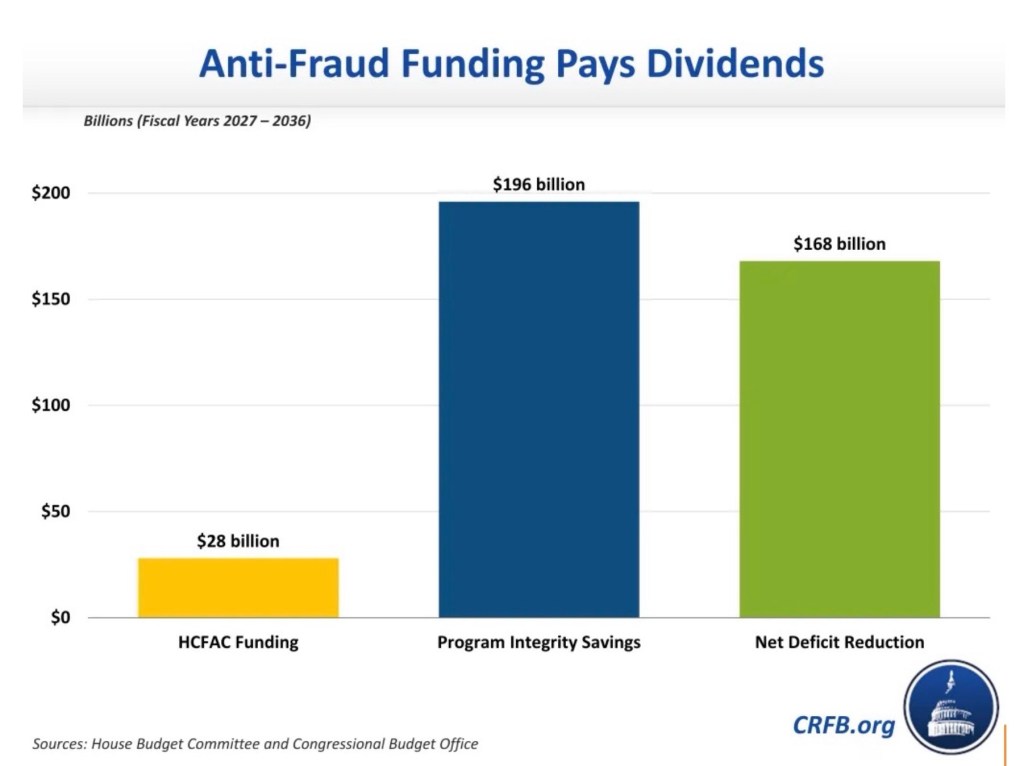
It is important to note that the estimated 7-to-1 ROI for anti-fraud funding is significantly higher than past estimates, including from HHS itself (although their estimated ROI for HHS Inspector General funding in particular is above 7-to-1), and so we hope to see more information to explain CBO’s expectation. Yet, given that health care programs are the government’s largest sources of improper payments and likely of waste, fraud, errors, and abuse, it is not surprising that program integrity funding would produce a meaningful return.
The Anti-Fraud Fund Act of 2026 is the second major program integrity funding bill introduced this year. The other, the Stop CHEATERS Act (S. 4298), would likely generate $100 to $200 billion of deficit reduction by funding the Internal Revenue Service (IRS) to reduce tax fraud.
Lawmakers should fund these efforts, along with similar ones like Social Security Continuing Disability Reviews, unemployment eligibility assessments and reemployment services, child support enforcement, and Inspectors General funding, which have shown positive ROIs for the federal government. They should also work to undertake additional efforts to reduce waste, fraud, errors, and abuse in health care and the budget at large.


