
Mention taxing Social Security and all kinds of opinions are expressed.
And no, you did not pay for your benefits via payroll taxes , you will very likely collect benefits far in excess of the taxes you (and possibly) your employer paid.
In the aggregate, retirees have paid for, by way of payroll taxes, about 15% of the total benefits they will receive.
Fixing social security requires adjustments applied to both current workers and current retirees. There will be some combination of paying more and receiving less in the future.
From the Committee for a Responsible Federal Budget
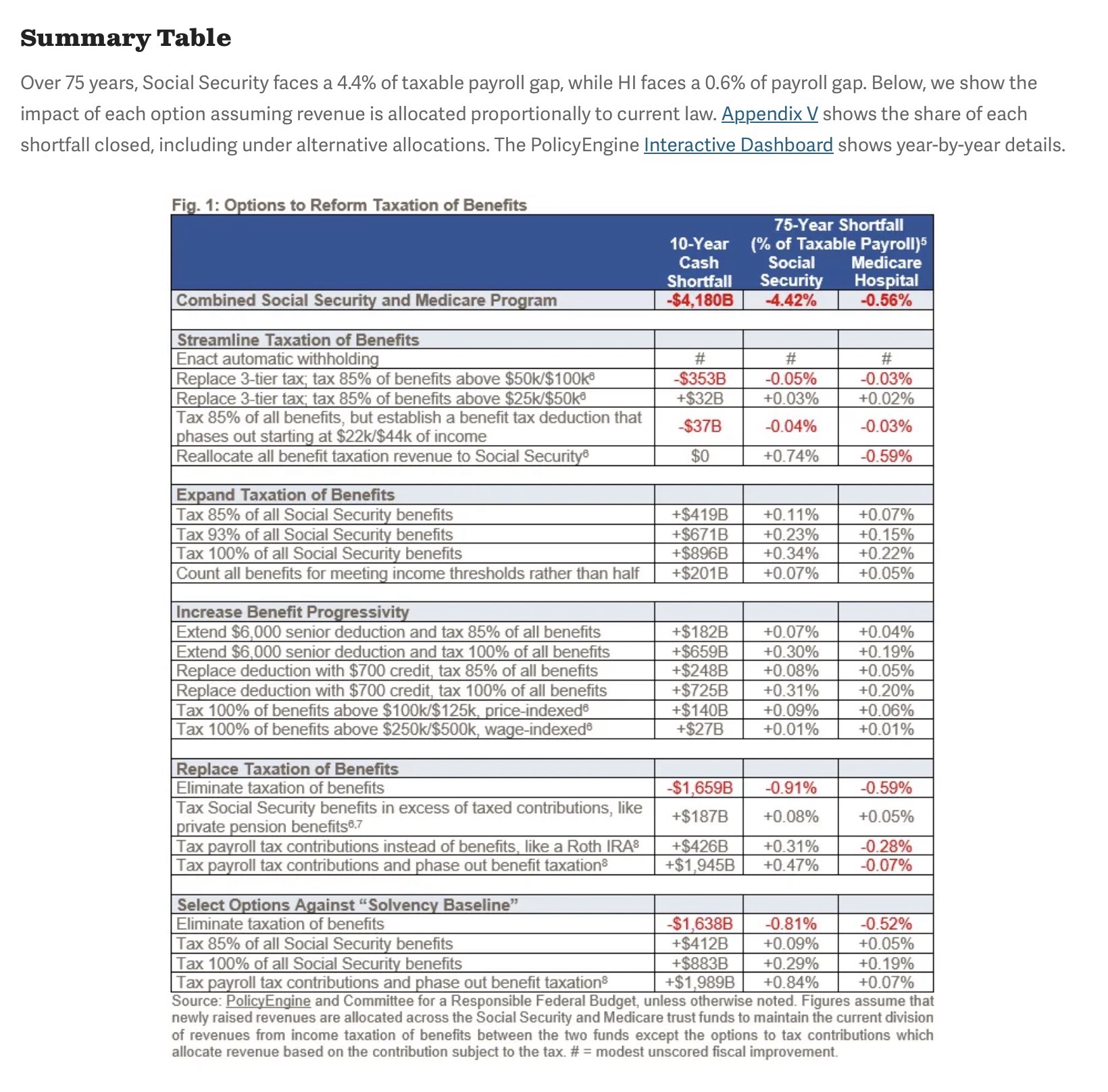
The link below is to a discussion about changing the taxation of Social Security benefits. Remember, income taxes paid on SS benefits go into the SS trust.
https://www.crfb.org/papers/new-approaches-social-security-benefit-taxation


“… And no, you did not pay for your benefits via payroll taxes , you will very likely collect benefits far in excess of the taxes you (and possibly) your employer paid. In the aggregate, retirees have paid for, by way of payroll taxes, about 15% of the total benefits they will receive. …”
All the above confirms is that in 1939, when Congress first amended the original Social Security to start benefit payments years prior to the date originally set, as well as to improve benefits, they shifted the program to pay as you go. They changed the program from a sustainable, funded entitlement to an intergenerational wealth transfer program.
Had they followed and adjusted the initial designs so that funding and benefits and investments provided a sustainable entitlement, worker contributions and those of their employer, properly invested, would have effectively funded the program.
For comparison, the nominal amount of my contributions and employer match to my 401k plans, contributions that started 47 years ago and continued through 2025 (compared to Social Security taxes, which I have paid for 52 years), are less than 10% of all assets in my 401k and IRA accounts today.
Yes, we need to raise revenue and reduce benefits.
However, due to consistent Congressional and Presidential lying over decades, coupled with vote buying improvements in benefits without appropriate funding, alongside stupid investment decisions of surplus assets that would not be needed for decades, all to enable excessive federal spending … now including ~$2 Trillion a year in annual federal deficits …
When people are lied to, for decades, why would you think they don’t believe what they are told?
You and I may know better because of our 40+ years of benefits experience, but …
LikeLike