
There is so much false and misleading information and false information about Social Security floating around, some facts are helpful … for those who want truth. 😢
The Social Security system relies on two dedicated accounts—the Old-Age and Survivors Insurance (OASI) and Disability Insurance (DI) Trust Funds. Money flows into these funds from three primary income channels, passes through a holding mechanism of U.S. Treasury bonds, and is distributed across four major beneficiary groups.
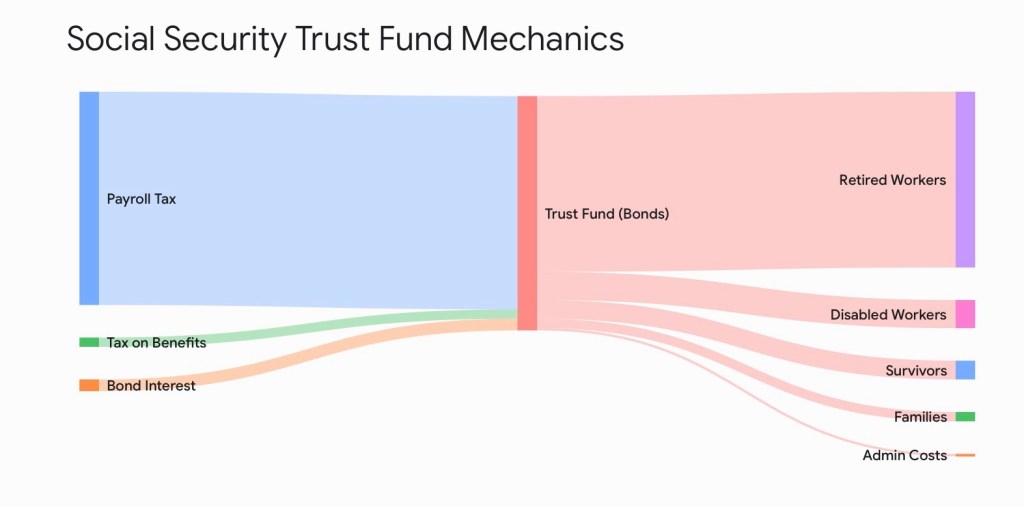
Income Streams into the Trust Fund
Social Security generates annual income totaling over $1.3 trillion from three main sources:
Payroll Taxes (FICA / SECA) (~91%): The primary funding engine. Employees and employers each pay a 6.2%tax on wages up to the annual taxable maximum, while self-employed workers pay 12.4%.
Interest on Treasury Bonds (~5%): Special-issue Treasury securities held by the Trust Funds earn interest paid by the federal government.
Taxation of Benefits (~4%): Higher-income beneficiaries pay federal income taxes on up to 85% of their Social Security benefits, which are remitted back to the Trust Funds.
The Treasury Bond Holding Mechanism
By law, Social Security revenues cannot be invested in private assets like stocks or corporate bonds. Instead, they flow through special-issue U.S. Treasury Securities:
How the Surplus Era Worked (1983–2009/2020): When annual tax revenues exceeded benefit outlays, the excess cash was automatically transferred to the U.S. Treasury. In return, the Treasury issued interest-bearing, non-marketable special-issue bonds to the Trust Funds. The federal government used the borrowed cash to fund general operations, while the Trust Fund built up a reserve of guaranteed bonds earning annual interest.
How the Current Deficit Era Works (starting in 2021): Today, annual benefit spending exceeds incoming tax receipts. To cover the cash deficit, Social Security redeems its Treasury bonds for cash, drawing down the Trust Fund reserve while the Treasury borrows from the public to pay the redemptions (as it does for all debt issued by the government).
3. Benefit Expenditures by Recipient Group
Over 99% of Trust Fund expenditures go directly to benefits, with administrative costs taking less than 1%. The roughly 68+ million beneficiaries receive payouts in the following proportions:
Retired Workers
~76%
Monthly benefits paid to workers who have reached retirement age and accumulated at least 40 credits.
Disabled Workers
~12%
SSDI benefits paid to workers with severe medical conditions that prevent gainful work.
Survivors
~8%
Benefits paid to surviving widows, widowers, and minor orphans of deceased covered workers.
Spouses & Children
~4%
Dependent benefits paid to eligible family members of active or retired workers.


