
Universal health insurance may never happen, but not because of “intelligent and educated” people as claimed below, but rather because of uninformed people who post memes like this one below from Threads.
Let’s be clear, the issue is not universal healthcare, it is universal insurance- similar to Medicare. Not a program that covers every possible health care related service in total as suggested by Sen Sanders. And nobody is promising that universal coverage will be “free.”
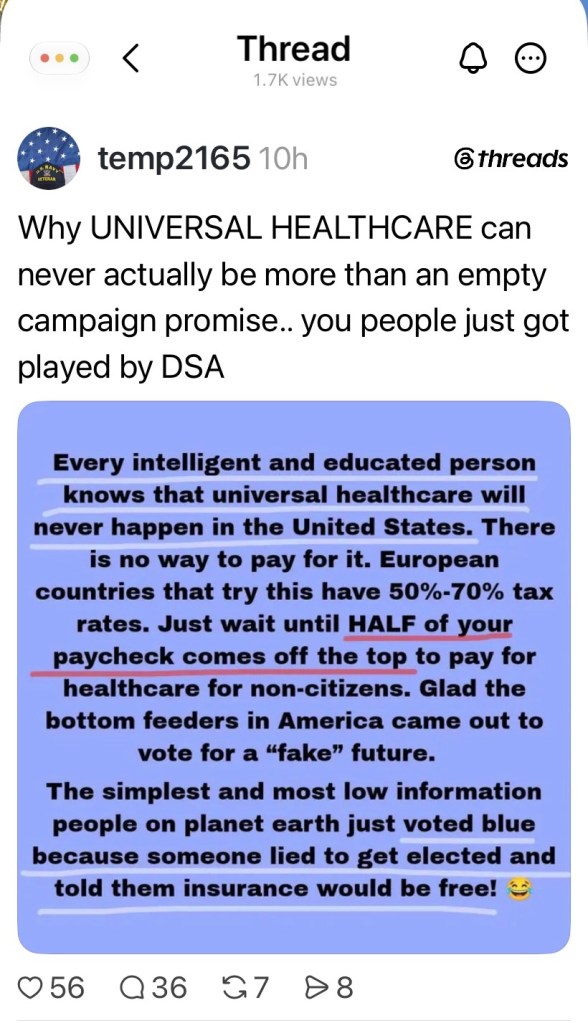
The ignorance displayed in the above meme is appalling, but not uncommon. Yeah, it’s political, but still ignorant.
Let’s ignore the really nonsense remarks and focus on no way to pay for it? Are you kidding, we already pay for it‼️
U.S. employers (combining private businesses and state/local governments) pay approximately $1.15 trillion to $1.25 trillion annually for employee health insurance coverage.
In addition, because employer contributions are exempt from FICA (payroll) taxes as well as federal income taxes, the total revenue foregone across both income and payroll taxes combined exceeds $380 billion to $400 billion per year.
State Income Tax Loss: Because most states align their taxable income definitions with the federal system, states lose an estimated $35 billion to $45 billion collectively in state income tax revenue each year.
Also, many employers use IRC Section 125 which exempts employee contributions towards health benefits from taxes. There is no separate revenue loss estimate. However, eliminating this tax break extends Social Security solvency by three years and closes an estimated 8% of the funding gap That’s an idea of the lost tax revenue.
Total national spending on Medicaid—combining both federal and state contributions—is approximately $920 billion to $950 billion annually.
By diverting all that spending plus reasonable premiums and typical patient cost-sharing, universal insurance similar to Medicare could be funded. In fact, it could quite possibly be funded for less.
Then we have the matter of ideology. The people who claim they don’t need or want any government involvement in things like health insurance … or much else in extreme cases. Also, there areare people who see taxes as theft, a scam and other nonsense.
Of course there are also people who don’t want any part of paying collectively for someone else (especially when it comes to healthcare, they already are) … and not very efficiently. When it comes to society helping society through taxation, in some minds that is socialism to be avoided at all cost.
And what is that cost?
Americans report significant struggles with all of the following financial obligations though the intensity and prevalence vary. Recent surveys (primarily 2025–2026 from Pew, Gallup, Federal Reserve, AARP, NIRS, and others) show healthcare and retirement savings as broad concerns affecting large shares of the population, while childcare, elder/long-term care, and college costs hit specific groups hardest (parents, sandwich-generation caregivers, and families with students).
How do Americans feel about their healthcare coverage?
An NBC News Decision Desk/SurveyMonkey poll (late 2025) found Satisfaction was highest among those 65+ (around 9 in 10) and those on Medicare or Medicaid (nearly 9 in 10), versus about 77% for private coverage.
eHealth surveys around open enrollment for 2026 found 77–88% of respondents felt good about or were satisfied with their coverage options, with Medicare beneficiaries and those with employer plans reporting the highest levels.
Public programs like Medicare often score higher on satisfaction than commercial/employer or marketplace plans.
Latest available 2025 data: Adults ages 19–64 had an uninsured rate of approximately 11%. The rate for children was about 5.8%. Census.gov
Then there are people who have insurance but cannot afford their deductibles, copayments, or medical bills. The percentage facing those affordability problems is considerably higher.


Keep in mind that when it comes to health care, and health care insurance, “Americans want the best health care and coverage YOUR money will buy!” You can quote me.
LikeLike
Sorry, universal health care coverage also means extending the below cost allowable amounts used in Medicaid and Medicare today to all who would be covered under a “universal” system, or eliminating those below cost allowable amounts for everyone in the “universal” system. Couple that will caps on balance billing. Under the former, you will have rationing. Under the latter, costs will explode.
Just as important, extending a Medicare benefit structure, without any cap on out of pocket costs (as exists in traditional Medicare today), won’t sell.
And, the main reason costs are “unaffordable” today for those who are not covered under a government sponsored plan that limits allowable charges (Medicare, Medicaid and VA), is because every household with employer-sponsored coverage is not only paying 100% of the cost of their employer sponsored coverage (through contributions or reductions in wages), but also paying general revenue taxes and FICA-Med taxes to fund others benefits.
If a “universal” coverage scheme doesn’t address the incidence of costs as they are allocated today (the perceived costs), and if it doesn’t address the ultimate impact of costs as they are allocated today (as incidence doesn’t equal impact), you won’t provide any more relief than what was “accomplished” by Health Reform (“Obamacare”) – a promise of relief delivered to some (more vote buying for favored population), that is paid by extra costs assessed to others (the unfavored population) … followed by continued increases in cost.
As Herb Stein, economist once said, famously, “If something cannot go on forever, it will stop.”
Simply, at some point, cost increases will either prompt structured rationing (“Quality-Adjusted Life Years”), curtailment of medical product and services innovation, reductions in terms of access (delays, unavailable, etc.), or, rationing by price/cost.
LikeLike