
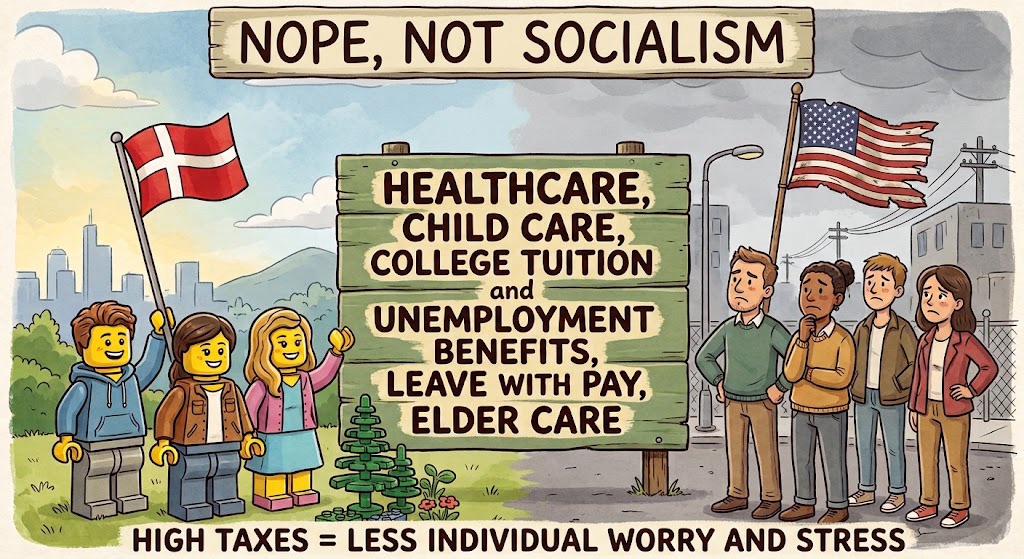
For those uninformed folks crying “socialism” and confiscation of their income, keep in mind the three most social minded, high taxed countries in the world have 1,214,000 millionaires and 76 billionaires out of a population of only 22 million.
The percentage of the population in Scandinavia that are millionaires is only 1.5 to 2% less than the USA.


Public Finance 101 Principles:
(Yes, Virginia, there is a whole economic “science” behind modern taxation)
know where their tax dollars are being spent
revenue decisions – accountable government
Local Taxes:
– Benefits received from local services
– Ability to pay
Federal Taxes:
Federal taxation in public finance theory balances economic efficiency, equity (fairness), and administrative feasibility to fund government operations and manage macroeconomic stability.
• Horizontal equity dictates that taxpayers with equal economic capacity should bear equal tax burdens.
• Vertical equity addresses how the burden shifts across income levels, typically achieved through progressive rate structures.
When Congress diverts from goals of equity, efficiency, simplicity, as demanded by members of our 2027 Congress, no one should be surprised to see taxpayers recoil, resist, reject taxes.
It is when voting every two years doesn’t satisfy the requirement of “no taxation without representation.”
LikeLike
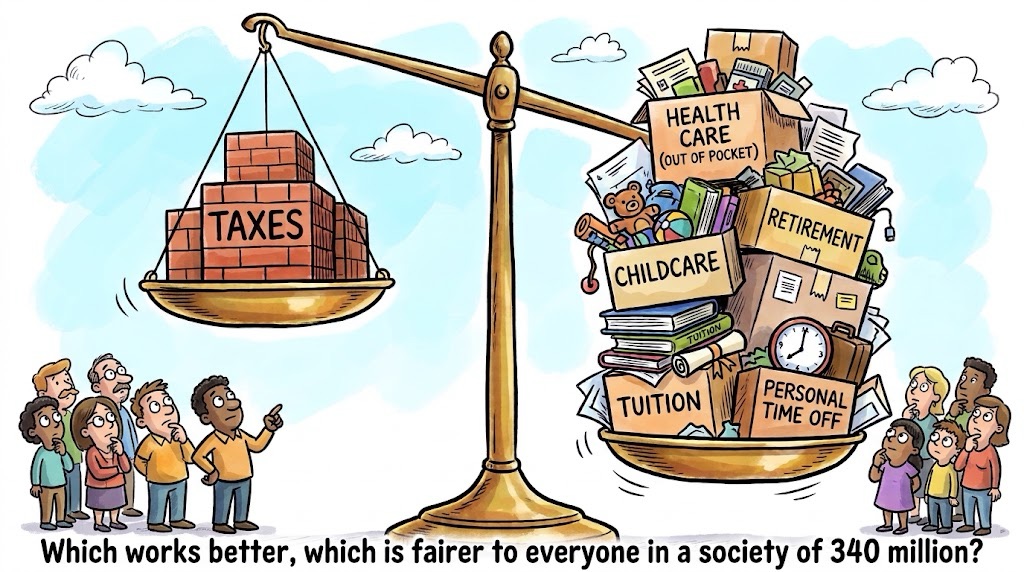
Which works better. Which is fairer to everybody in a society of 340 million?
“Fair”?
According to the IRS, “we have taxes in the United States to fund the public services, infrastructure, and government operations that a functioning society requires but individuals cannot easily provide on their own.”
Taxes provide revenue for federal, local, and state governments to fund essential services–defense, police, a justice system– benefitting all citizens (and others lawfully present), who could not effectively and efficiently provide such services for themselves. These are required payments of money to governments that are used to provide for the community as a whole – where everyone benefits as a member of society.
No one challenges those taxes – they don’t call them “essential services” for nothing.
Then there are services for items available to the general public – available to everyone, even though some won’t ever use them – schools, parks, highways, roads, airports, certain utilities, etc. So long as people get to vote on whether to fund those with their taxes, they remain free to vote yes or no or to “vote with your feet” – as sometimes happens when people decide the local/state tax burden is too substantial.
The challenge comes in, when you and others define “fair” the way you see it, when the word “fair” is used to justify federal taxation that takes more from some in order to benefit others – often, to buy votes. It is challenging when taxes are assessed against disfavored populations (where members of Congress don’t believe new taxes will cost them any votes) while the benefits they fund are expected to buy them votes.
This is the challenge of socialism – when Congress votes benefits to be delivered to their favored population, while the taxes will be assessed against disfavored populations, as well as individuals who are too young to vote, and generations yet unborn. There are other members of Congress (a lot more starting in 2027) who believe it is “fair” to take all a person has beyond what they need for their personal use – in order to fund social programs and services that benefit only certain citizens, such as health, welfare, and other services.
The problem, of course, is that unlike state and local taxes, the taxpayer has no lawful option to avoid federal taxes that target them because some in Congress disfavor them … remember taxpayers don’t get to decide whether the benefits beyond “essential services” funded with federal dollars (or deficit spending) are worth the reduction to their wealth … today and tomorrow.
As Margaret Thatcher once said, famously: “The problem with socialism is that you eventually run out of other people’s money.”
According to the Brookings Institution’s Vanessa Williamson in her 2017 book, Read My Lips: Why Americans Are Proud to Pay Taxes: “…The act of taxpaying taps into Americans’ fundamental political values: their sense of fellowship with other people and their feeling of representation by the government…. It’s the distasteful nature of taxpaying that makes ‘shared sacrifice’ such a powerful component of citizenship.”
The issue is that some define “fair” with bias, while ignoring “equity”.
To them, “fair” means treating me the way I think I should be treated – in terms of taxes and benefits.
However, taxation that cannot be avoided, shouldn’t be fair. Instead, the metric should be equity:
Horizontal equity: Treating similarly situated people the same, and
Vertical equity: Treating differently-situated people differently, proportionately.
LikeLike