
Some Americans are obsessed with doing away with their version of socialism, as inaccurate as it may be. Socialism is not a system providing a strong social safety net.
But there is something more important in comparing high taxes with risk and true out of pocket costs.
Lower taxes are not necessarily a net benefit and definitely do not spread risk financial stress equally.
Here is a summary of what people in Denmark receive for their high taxes.
• Pensions, unemployment, and social support: Strong safety nets including unemployment benefits (often high replacement for a period), old-age care, disability support, and housing allowances. Reduces fear of poverty or job loss.
No out of pocket college expenses. no tuition plus a monthly living expense stipend.
• Paid vacation: Minimum 5–6 weeks by law, plus holidays—vs. variable/lower in the US.
• Elderly/disability care: Publicly supported home care and facilities.
Trade-offs and Context
Denmark’s system emphasizes universalism (benefits for all, funded by broad taxes including high VAT ** and income taxes), leading to high trust, lower inequality, better health/life expectancy outcomes, and high happiness rankings. However, gross salaries can be lower in some fields, cars/housing are expensive, and high earners face steep marginal rates.
Americans often pay comparable or higher effective costs when adding private expenses (health insurance + childcare + tuition + medical debt risk), but with more variability, administrative hassle, and insecurity.
And the level of financial stress varies greatly by income and family circumstances – but many Americans don’t see that as a concern or don’t see it at all.
Net disposable income after these “hidden taxes” can be competitive or better in Denmark for many families, especially middle-class ones with kids.
In short, Danish taxes “pre-pay” for security and services that create less financial anxiety around life’s big costs, while the US system with lower taxes shifts more risk and expense to individuals.
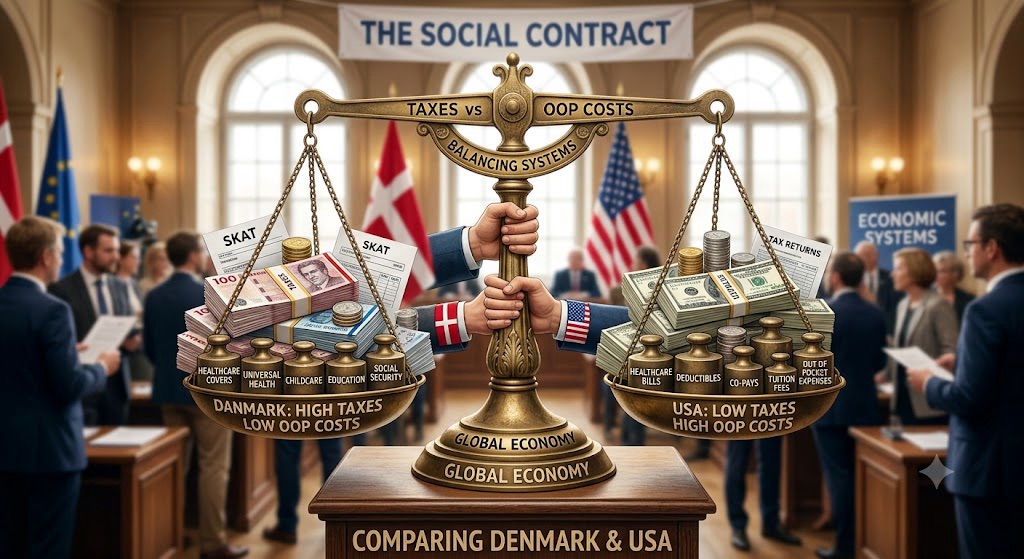
Outcomes vary by personal situation (income, family status, health), but the Danish model trades higher visible taxes for lower out-of-pocket volatility.
Data is drawn from OECD, government reports, and comparisons as of recent years (2024–2026).
So, while the current US political climate favors individual empowerment, lower taxes to use your money as you see fit, and less government involvement, many, perhaps most, Americans are not getting a better deal than Scandinavians who still live in capitalist countries.
** The VAT rate is 25% in Denmark, Norway, and Sweden, with Norway and Sweden adding lower rates for specific categories, while Denmark effectively uses a flat 25% for almost everything subject to VAT.
The effective tax rate for a middle income worker earning about $76,000 is between 35-38% but varies by municipality.
Denmark is a capitalist country, it does not follow the extreme nonsense of the Democratic Socialists of America which is a social action lobbying group with branches in every state.
Denmark has 8 to 15 billionaires (according to recent Forbes data tracking depending on individual or family wealth) and approximately 366,000 dollar millionaires.


